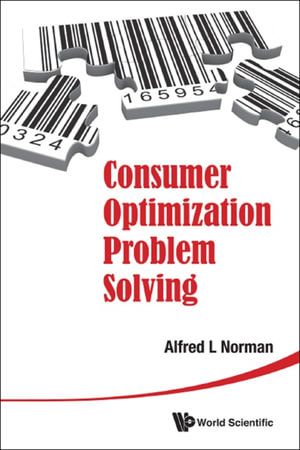
What algorithms are tractable depends on the speed of the processor. Given the speed of digital computers, polynomial algorithms are considered tractable. But, a human can take several seconds to make one binary comparison between two pens. Given this slow speed, sublinear algorithms are considered tractable for an unaided human and this defines Simon's concept of bounded rationality.
Humans make simplifications to solve the intractable consumer optimization problem. Consumers search for goods and services item-by-item, which greatly reduces the number of alternatives to consider. In addition, consumers have operators that can process a set in a single operation. Also, consumers budget by incremental adjustment.
In considering consumer performance the question to ask is how close to optimal is consumer performance and not whether consumers optimize as a yes/no question. Given the ordinal nature of utility theory this creates a basic measurement problem. The book presents a review of the literature on consumer performance.
This is an opportune time to study consumer procedures because the Internet provides a media to make substantial improvements in consumer performance. The book includes a case study comparing the performance of a digital camera selection code with the advice of sales people. A field experiment demonstrates that the software code provides better advice.
Contents:- Introduction
- Computational Complexity
- Ordering
- Computational Complexity: Decision Rules
- Repeated Price Search
- Repeated Item Search: Forecasting
- Repeated Item Search: Choice
- Budgeting
- How Close to Optimal?
- Improving Consumer Performance
- Appendix: CC of the Discrete Two-Stage Budgeting Problem
Readership: Students at postgraduate level and academics researching theoretical, computational, behavioural and experimental economics with a specific focus on consumer behaviour, decision making, and optimization.