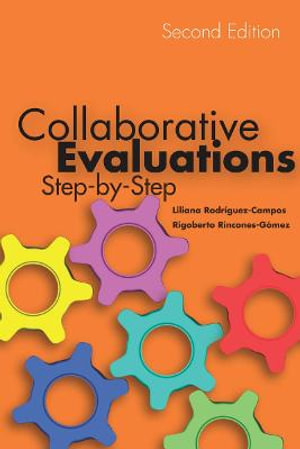
Collaborative Evaluations: Step-by-Step, Second Edition is a comprehensive guide for evaluators who aim to master collaborative practice. Liliana Rodriguez-Campos and Rigoberto Rincones-Gomez present their Model for Collaborative Evaluations (MCE) with its six major components: identify the situation, clarify the expectations, establish a collective commitment, ensure open communication, encourage effective practices, and follow specific guidelines.
Fully updated to reflect the state-of-the-art in the field, each core chapter addresses one component of the model, providing step-by-step guidance, as well as helpful tips for successful application. To further demonstrate the utility of the MCE, this new edition includes recurring vignettes about several evaluators and clients, illustrating frequent questions and specific challenges that arise when evaluators take a collaborative approach. Drawing on a wide range of collaborative evaluations conducted in the business, nonprofit, and education sectors, this precise and easy-to-understand guide is ideal for students and practitioners who want to use its tools immediately.
Industry Reviews
"Professional competence in the practice of evaluation now requires a thorough understanding of the most widely used trio of evaluation models - participatory, collaborative, and empowerment evaluation. This means more than - though it must include - their definitions and differences. It means an understanding of the great range of practical details and difficulties that each involve. This book is the best way to get that essential understanding of collaborative evaluation, which is, in my view, the most sensible of the three approaches: It's well-organized, clearly written, interesting, and comprehensive - really earning the title of a handbook." - Michael Scriven, Professor of Psychology, Claremont Graduate University and Past President, American Evaluation Association and American Educational Research Association "This book is a powerful and essential tool for community-based organizations preparing to increase service delivery and program outcomes. Decreased funding has caused many leaders to shift their focus to new approaches to stakeholder involvement. National centers are raising funding accountability. This book is the #1 guide for leaders." - Debra E. Thrower, Professor of Social Work, Saint Leo University "Collaborative Evaluations is a practical guide which demystifies evaluation with a user-friendly language and simple descriptions of its purpose and the process. Through the Model for Collaborative Evaluations, the book offers experienced practitioners, as well as neophytes, a tool that builds on what evaluation is all about: managing human relationships. I would recommend this improved second edition to all who believe that effective stakeholder engagement is key to the usefulness of evaluations." - Dieudonne Mouafo, Chief, Evaluation Unit, United Nations Volunteers "For too long, evaluation has been viewed as something done to programs rather than with programs. This book demonstrates how evaluators and program operators can work together more closely and productively. It offers practical advice on how to clarify roles and expectations, ensure open communications, and engage people in the evaluation process." - Thomas Brock, Director, Young Adults and Postsecondary Education, MDRC "This engaging book is a must read for anyone who cares about making the evaluation process more useful and inclusive. The Model for Collaborative Evaluations is a refreshing, new framework from two noted scholars that provides helpful tools to build relationships that strengthen the process and involve stakeholders at every stage." - Caroline Altman Smith, Senior Program Officer, The Kresge Foundation