October, 1931. Albert Glotzer, a young American revolutionary, arrived in Kadikoy, Turkey, for an eagerly anticipated meeting with Leon Trotsky. Of that day, Glotzer writes: "In accented English, he invited me to his buro . . . As I sat talking, I observed the famous head, with its shock of gray hair, the high forehead, the penetrating blue eyes behind the horn rims, the full lips framed by dimples that deepened with his smile or laughter . . . The resonance of his high tenor reminded me of his legendary oratorical prowess . . . Even though he had been almost crushed by the new bureaucracy organized and led by Stalin, Trotsky bore not the slightest air of defeatism. His self-imposed task, in his latest exile, was nothing less than to try to build a new movement from minuscule beginnings."
To this day, Leon Trotsky remains officially condemned in a nation he, with Lenin, was most responsible for establishing. He is still publicly regarded as the Soviet Union's greatest traitor. Yet perhaps the changes now sweeping the communist empire offer hopes of posthumous acknowledgement of the man Lenin called "the best Bolshevik."
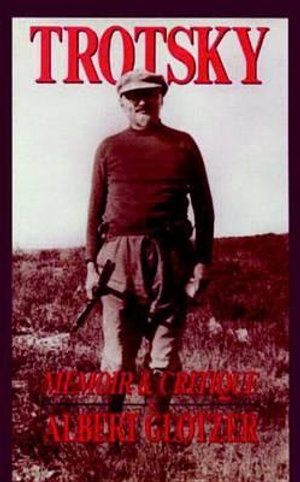
In Trotsky: Memoir and Critique, Albert Glotzer, a close associate of Trotsky in the 1930's, provides a comprehensive and compelling portrait of the man and the movement he inspired. Glotzer vividly recounts the years during which Trotsky was in exile, documents Trotsky's dramatic testimony at the Dewey Commission hearings in Mexico City, reviews his political role in Bolshevism, and eloquently explains his failure to be accepted by Soviet leaders after Lenin's death. In chapters that alternate between absorbing first-hand anecdotes and acute appraisals of Trotsky's prophetic insights, Glotzer shows why a man murdered more than forty years ago in Mexico still casts so large a shadow over the nation of his birth.
Industry Reviews
Readers familiar with the complicated history of international Communism will find much to interest them here. Those less well-informed may find Glotzer's work heavy going, filled as it is with convoluted analyses of the various strategies, motivations, and duplicities of the Stalinist and Trotskyist positions via-a-vis the Communist revolution. Octogenarian Glotzer is uniquely qualified to expound his theories about Trotsky the man and the political theoretician. At the age of 23, the author, then a member of the Communist League of America, was sent to Turkey to meet with the exiled Trotsky as a representative of the National Committee of the CLA. He spent several weeks living in Trotsky's house, handling some correspondence, acting as an unofficial guard, and holding occasional discussions with the Russian giant. His reminiscences are intriguing, and his portrait of the household affectionate. Glotzer later met Trotsky in Mexico, where Glotzer acted as court recorder for the 1937 Dewey Commission assembled to investigate the charges made against Trotsky in the Stalinist Trials in Moscow. His recollections of these hearings are not only highly informative but surprisingly immediate after more than 50 years - as is the portrait of Trotsky presented here, sympathetic though not hagiographic. When discussing Trotsky's political influence on Bolshevism, Glotzer is straightforward in pointing out Trotsky's shortcomings, his occasionally inexplicable decisions, even what could be regarded as his opportunism - as in his espousing the Bolshevik position despite his earlier violent opposition. Glotzer reveals that he broke with Trotsky in 1940 over the Hitler-Stalin Pact and "the Russian Question." A noteworthy contribution to an understanding of 20th-century political history. (Kirkus Reviews)