Get Free Shipping on orders over $79
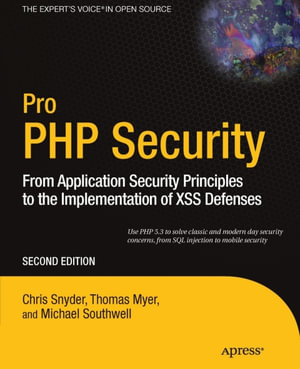
Pro PHP Security : From Application Security Principles to the Implementation of XSS Defenses - Chris Snyder

Pro PHP Security

From Application Security Principles to the Implementation of XSS Defenses

By: Chris Snyder, Thomas Myer, Michael Southwell

eText | 29 July 2011 | Edition Number 2

At a Glance

eText


$119.00

or 4 interest-free payments of $29.75 with

 or 

Instant online reading in your Booktopia eTextbook Library *

Why choose an eTextbook?

Instant Access *

Purchase and read your book immediately

Read Aloud

Listen and follow along as Bookshelf reads to you

Study Tools

Built-in study tools like highlights and more

* eTextbooks are not downloadable to your eReader or an app and can be accessed via web browsers only. You must be connected to the internet and have no technical issues with your device or browser that could prevent the eTextbook from operating.

PHP security, just like PHP itself, has advanced. Updated for PHP 5.3, the second edition of this authoritative PHP security book covers foundational PHP security topics like SQL injection, XSS, user authentication, and secure PHP development. Chris Snyder and Tom Myer also delve into recent developments like mobile security, the impact of JavaScript, and the advantages of recent PHP hardening efforts.

Pro PHP Security, Second Edition will serve as your complete guide for taking defensive and proactive security measures within your PHP applications. Beginners in secure programming will find a lot of material on secure PHP development, the basics of encryption, secure protocols, as well as how to reconcile the demands of server-side and web application security.

What you???ll learn
  • Secure PHP development principles
  • PHP web application security
  • User and file security
  • Mobile security
  • Encryption and secure protocols
  • Dealing with JavaScript
Who this book is for

Pro PHP Security appeals to all intermediate and advanced PHP programmers who need to keep websites safe. It also contains material of interest to all who are concerned with web application security.

Table of Contents
  1. Why Is Secure Programming a Concern?
  2. Validating and Sanitizing User Input
  3. Preventing SQL Injection
  4. Preventing Cross-Site Scripting
  5. Preventing Remote Execution
  6. Enforcing Security for Temporary Files
  7. Preventing Session Hijacking
  8. Securing REST Services
  9. Using CAPTCHAs
  10. User Authentication, Authorization, and Logging
  11. Preventing Data Loss
  12. Safe Execution of System and Remote Procedure Calls
  13. Securing Unix
  14. Securing Your Database
  15. Using Encryption
  16. Securing Network Connections: SSL and SSH
  17. Final Recommendations
on
Desktop
Tablet
Mobile

More in Web Programming

Spring AI in Action - Craig Walls

eBOOK

Total Typescript - Matt Pocock

eBOOK

RRP $81.32

$65.99

19%
OFF
Critical Web Design - Xtine Burrough

eBOOK

RRP $127.08

$101.99

20%
OFF