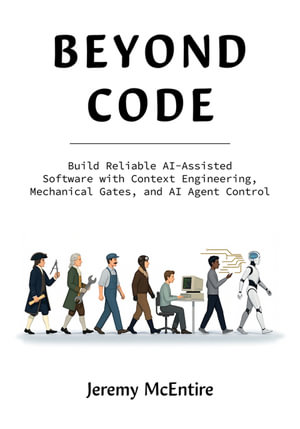
Discover why AI changes engineering by moving attention from code output to durable decisions, safer boundaries, and shared understanding
Key Features
- Apply context engineering to control what AI coding agents see and produce
- Replace subjective code review with mechanical gates and executable acceptance criteria
- Design and coordinate multi-agent workflows that close the build-test-deploy loop reliably
Book Description
The advent of AI coding agents has triggered an identity crisis in tech. But the core of software engineering was never just about writing syntax. It is about solving problems, defining constraints, and translating business reality into scalable software solutions. Beyond Code is the practitioner's survival guide to the new landscape of software development, teaching you how to stop competing with the machine and start directing it. The book covers the forces that determine whether AI assistance produces reliable software: context discipline, which shapes what agents see and what they ignore; mechanical gates, which replace advice-based review with verifiable pass-fail conditions; and loop closure, which keeps multi-agent coordination from drifting off-mission through Goodhart traps and proxy decay. You will work through input design, information filtering, decomposition as constraint topology, hierarchical agent coordination, and multi-pass thinking for output verification. By the end of this book, you will be able to manage the information environment your AI agents operate within, enforce the constraint structures that keep them aligned, and build multi-agent workflows that close the build-test-deploy loop without fragile handoffs or compounding failures.
What you will learn
- Engineer context to control what AI coding agents produce
- Filter irrelevant information that degrades model output quality
- Use decomposition to create verifiable, independently testable seams
- Replace code review opinions with executable mechanical gates
- Identify and escape Goodhart traps in developer metrics and evals
- Coordinate AI agents hierarchically to reduce overhead and drift
- Apply multi-pass thinking to catch failures before they compound
- Translate software decisions into terms that align engineering teams
Who this book is for
This book is for developers, software engineers, tech leads, engineering managers, and architects who want to stay effective as code generation becomes a default part of the development workflow. It is particularly useful for those who have started using AI coding tools in production and are noticing where the outputs break down in system coherence, review quality, or team alignment. Readers should have experience building, reviewing, or leading software projects.