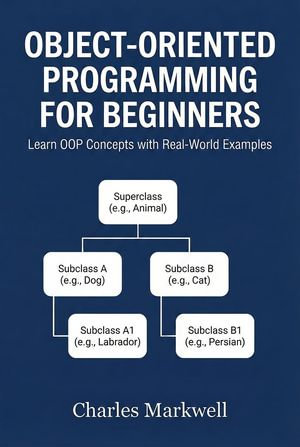
Transition from disorganized scripting to building robust, scalable software architectures.
Many self-taught developers and computer science students encounter a significant plateau in their programming development. While you may possess a strong grasp of variables and loops, constructing complex applications often results in code that is difficult to maintain and prone to errors. Resolving a single issue can inadvertently introduce multiple new defects, leading to a cycle of inefficiency.
The solution lies not in acquiring a new programming language, but in adopting a fundamental shift in architectural thinking.
Object-Oriented Programming (OOP) serves as the industry standard for designing large-scale software systems. It facilitates the decomposition of complex problems into manageable, self-contained modules. This book acts as a comprehensive bridge, guiding you from writing linear scripts to architecting professional-grade systems.
Designed for beginners and intermediate programmers, this guide simplifies complex academic concepts, focusing on practical application. You will apply these concepts to build realistic software, including a Smart Home Device Manager and a Service Booking Platform.
What You Will Learn:
- The Four Pillars: Master Encapsulation, Abstraction, Inheritance, and Polymorphism to create flexible and maintainable codebases.
- Memory Management: Gain a deep understanding of the Stack and the Heap to eliminate bugs and optimize application performance.
- The SOLID Principles: Apply the five fundamental rules of design that distinguish amateur coding from professional software engineering.
- Design Patterns: Implement industry-standard solutions such as the Factory, Singleton, and Strategy patterns.
- Advanced Concepts: Explore composition, dependency injection, and exception handling to build fault-tolerant applications.
Why This Book Is Different:
While many programming resources rely on abstract, mathematical examples that can be difficult to contextualize, this book utilizes real-world analogies. You will model a car engine to understand encapsulation, design a zoo to understand polymorphism, and build a service marketplace to comprehend interfaces.
Although the code examples utilize a clean syntax compatible with Java and C#, the concepts presented are universal. Whether you utilize Python, C++, or JavaScript, the architectural skills acquired here will remain relevant throughout your career.
Who This Book Is For:
- Computer Science students seeking to visualize and internalize OOP concepts.
- Self-taught developers aiming to advance from junior to intermediate roles.
- Professionals desiring to write cleaner, more maintainable code.
Develop software that is not only functional but enduring.