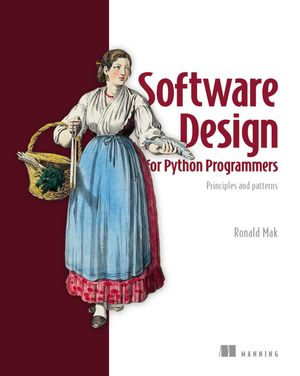
Software Design for Python Programmers shows you how to level up from writing Python code to designing Python applications. Following intuitive "before" and "after" examples of improved code, you'll learn to plan and execute Python applications effectively and avoid bugs associated with unmanaged state, poorly-formed classes, inflexible functions, and more.
Great applications take advantage of established design principles and patterns that maximize performance, maintainability, and reliability. This book helps you master the "Pythonic" approach to architectural principles, such as encapsulation, abstraction, method variation, and more. The examples are in Python, but the techniques will apply to any object-oriented language.
In Software Design for Python Programmers, you'll learn to:
- Analyze requirements and plan application architecture
- Evolve designs through iterative development
- Shape Python classes with high cohesion and loose coupling
- Use decorators to introduce abstraction, enforce constraints, and enrich behavior
- Apply industry-standard design principles to keep code modular and maintainable
- Choose and implement the right design patterns for complex challenges
About the Technology
Great software starts with thoughtful design. You'll be a more effective developer if you can decide how data will
flow through your applications, create a winning software architecture, and structure functions, classes, and modules before you write a line of code. This book will get you started!
About the Book
Software Design for Python Programmers is a practical guide for creating maintainable, well-structured software in Python. By investigating clear "before and after" examples, you'll discover how even small design choices can have a huge impact on an application's clarity and reliability. As you go, you'll learn how to gather requirements, shape a program's architecture iteratively, create clean and reusable abstractions, and select design patterns that solve the real problems you'll face on the job.
What's Inside
- Turn vague requirements into solid designs
- Python-specific software design techniques
- Create classes with high cohesion and loose coupling
About the Readers
For programmers comfortable with Python syntax.
About the Author
Ronald Mak is a former NASA senior scientist. Currently, he teaches data science and computer science at San Jose State University. He is the author of Object-Oriented Software Design in C++.
Table of Contents
Part 1
1 The path to well-designed software
2 Iterate to achieve good design
Part 2
3 Get requirements to build the right application
4 Good class design to build the application right
Part 3
5 Hide class implementations
6 Don't surprise your users
7 Design subclasses right
Part 4
8 The Template Method and Strategy Design Patterns
9 The Factory Method and Abstract Factory Design Patterns
10 The Adapter and Façade Design Patterns
11 The Iterator and Visitor Design Patterns
12 The Observer Design Pattern
13 The State Design Pattern
14 The Singleton, Composite, and Decorator Design Patterns
Part 5
15 Designing solutions with recursion and backtracking
16 Designing multithreaded programs