

Get Free Shipping on orders over $79
Large-Scale Graph Processing Using Apache Giraph : Computer Science (R0) - Sherif Sakr

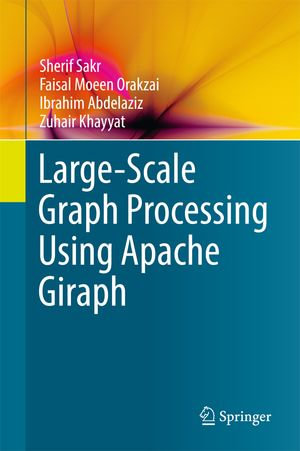
Large-Scale Graph Processing Using Apache Giraph

By: Sherif Sakr, Faisal Moeen Orakzai, Ibrahim Abdelaziz, Zuhair Khayyat

eText | 5 January 2017

At a Glance

eText


$89.99

or 4 interest-free payments of $22.50 with

 or 

Instant online reading in your Booktopia eTextbook Library *

Why choose an eTextbook?

Instant Access *

Purchase and read your book immediately

Read Aloud

Listen and follow along as Bookshelf reads to you

Study Tools

Built-in study tools like highlights and more

* eTextbooks are not downloadable to your eReader or an app and can be accessed via web browsers only. You must be connected to the internet and have no technical issues with your device or browser that could prevent the eTextbook from operating.

This book takes its reader on a journey through Apache Giraph, a popular distributed graph processing platform designed to bring the power of big data processing to graph data. Designed as a step-by-step self-study guide for everyone interested in large-scale graph processing, it describes the fundamental abstractions of the system, its programming models and various techniques for using the system to process graph data at scale, including the implementation of several popular and advanced graph analytics algorithms.

The book is organized as follows: Chapter 1 starts by providing a general background of the big data phenomenon and a general introduction to the Apache Giraph system, its abstraction, programming model and design architecture. Next, chapter 2 focuses on Giraph as a platform and how to use it. Based on a sample job, even more advanced topics like monitoring the Giraph application lifecycle and different methods for monitoring Giraph jobs are explained. Chapter 3 then provides an introduction to Giraph programming, introduces the basic Giraph graph model and explains how to write Giraph programs. In turn, Chapter 4 discusses in detail the implementation of some popular graph algorithms including PageRank, connected components, shortest paths and triangle closing. Chapter 5 focuses on advanced Giraph programming, discussing common Giraph algorithmic optimizations, tunable Giraph configurations that determine the system's utilization of the underlying resources, and how to write a custom graph input and output format. Lastly, chapter 6 highlights two systems that have been introduced to tackle the challenge of large scale graph processing, GraphX and GraphLab, and explains the main commonalities and differences between these systems and Apache Giraph.

This book serves as an essential reference guide for students, researchers and practitioners in the domain of large scale graph processing. It offers step-by-step guidance, with several code examples and the complete source code available in the related github repository. Students will find a comprehensive introduction to and hands-on practice with tackling large scale graph processing problems using the Apache Giraph system, while researchers will discover thorough coverage of the emerging and ongoing advancements in big graph processing systems.

on
Desktop
Tablet
Mobile

More in Business Mathematics & Systems

Communicating at Work - Tony Alessandra

eBOOK

C-Scape : Conquer the Forces Changing Business Today - Larry Kramer

eBOOK

HR 5.0 : Adapting to the AI-Enhanced Workforce - Dr Muskan Khan

eBOOK

RRP $194.88

$165.99

15%
OFF
Information Science : History, Ideas, Applications - Michael Seadle

eBOOK