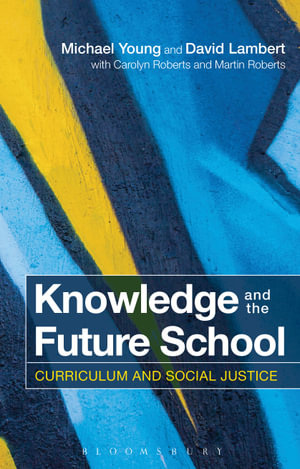
Michael Young and David Lambert introduce the idea of a 'Future 3' curriculum for knowledge-led schools in a clear, accessible and concrete way. They show how the question of knowledge is intimately linked to the issue of social justice. The Future 3 School engages directly with the principles underpinning the English government's curriculum proposals and offers a constructive alternative for how 'access to knowledge' is at the heart of a school's purposes.
The Future 3 School is the first book that draws on draws on and explains recent ideas in the sociology of knowledge and shows their relevance for those in schools. It distinguishes three models of the curriculum, referred to as Future 1, Future 2 and Future 3 in terms of their assumptions about knowledge and links Future 3 to the idea of 'powerful knowledge' for all pupils as a curriculum principle for any school. The concept of powerful knowledge is elaborated and its implications considered in practical and concrete terms. The authors argue that debates about knowledge are every teacher's (and indeed every parent's) concern. It argues that all pupils are entitled to access to 'powerful knowledge' and that this is largely but not solely acquired through specialist subjects. Furthermore, this idea provides a forward-looking framework for headteachers and their staff and those training to teach to draw on their own expertise in developing the curriculum for their school.aThe book offers clear answers to the following questions- why should all schools should be 'knowledge-led'?why are subjects crucial to a knowledge-led school?Why are knowledge-led schools not necessarily elitist?Why is 'powerful knowledge' a useful starting point for the education of all pupilsHow is a Future 3 version of a knowledge-led curriculum different from the government's Future 1 model?Why should Headteachers and senior staff see themselves as curriculum leaders not just managers?
Industry Reviews
[H]ighly accessible and jargon free ... [There is] much more to debate here than is possible in a brief review of this kind. My advice would be: buy the book and join the dialogue. * The Curriculum Journal *
The authors manage to avoid the boring old binary distinctions that tend to characterise debates about education and the purpose of teaching: and in doing so, promote a practical vision for the 'future school' that places the curriculum at its heart ... An engaging reminder of the need to avoid easy solutions, and to keep thinking. -- Jennie Bristow * Spiked *
Rather than simply critiquing recent educational reforms, the authors of this book offer school leaders and teachers a clear and practicable way of thinking about knowledge and the curriculum. This way of thinking affirmatively links pupils' entitlement to knowledge with social justice through the development of knowledge-led schools and curricula. After nearly three decades of reform aimed at de-professionalizing educators, this book ultimately makes an urgent and persuasive case for their re-professionalization in the name of providing pupils with more equitable access to powerful knowledge. * Brian D. Barrett, Associate Professor, Foundations and Social Advocacy Department, The State University of New York College at Cortland, USA *
I thoroughly recommend this book. It is carefully argued, thought-provoking and timely. Surely we can now move away from the often sterile and simplistic debates, "knowledge versus skills". Knowledge and the Future School presents us with a tantalizing alternative that will allow us to embrace the goal of widening access to 'powerful knowledge' through teaching framed by subjects, while at the same time celebrating the diverse experiences of students. * Dame Celia Hoyles, Professor of Mathematics Education, Institute of Education, University of London, UK *
This book raises important questions about the place of knowledge in education and society. Whether you agree with all the answers or not, any serious minded educator or researcher with an interest in social justice, should pay careful attention to the arguments that Young and his collaborators are making. * Keri Facer, Professor of Educational and Social Futures, University of Bristol, UK *
You don't need to agree with every argument in this highly engaging book to appreciate the importance of its challenges. Let's think about what schools are actually for. Let's stop seeing their important work only in terms of data, targets, what can be measured. Here are some serious (but far from dull) arguments about knowledge and the work of schools. This book cuts across the usual political debates and point-scoring. It is a model of how to write well for an audience that should include teachers and head teachers, parents, the public - and politicians. * Lyn Yates, Foundation Professor of Curriculum, University of Melbourne, Australia *
This is the book that many secondary school heads of department, frustrated by a focus on the pedagogic 'how?' at the expense of the disciplinary 'what?', have long been wanting their senior leaders to read. The authors' message is bold and its implication clear: disciplinary knowledge and curriculum thinking must become nothing less than the central concern of leadership, the essence of staff development and the driver of whole-school debate. * Christine Counsell, Senior Lecturer, Faculty of Education, University of Cambridge, UK *
Knowledge and the Future School is an intelligent and courageous book that takes the reader to the very heart of what a good education in our schools should be. The authors have adeptly argued the case for a subject-led curriculum that not only enlightens, stretches and challenges the pupil but also brings joy in learning and teaching. Here teachers are given back the freedom to be 'sage' and 'guide' in their classroom as they reflect how best to enthuse a deep understanding of their subject. This approach puts the teacher as the academic professional in the classroom who not only helps his students to develop higher order thinking skills through the discipline of his subject but also gives permission for the teacher to deepen his own knowledge and understanding by working and learning with other professionals from school and universities within his discipline.
The clarity of the message of this book cannot be mistaken. All children no matter their class or level of deprivation have a legitimate entitlement to powerful knowledge that is found in a subject led curriculum. This book is not about a traditional curriculum of the past which is rigid and requires just rote learning. Nor does it allow inequalities where pupils with less means are 'fobbed off' with a third class curriculum based on pupils' own experience giving them no real choices for their future. This book sets a demanding environment of a subject based curriculum that is not afraid to state knowledge is power led by a reflective practitioner who invests in both his pupils and his own understanding of the subject.
This is a most liberating book that leaders in education, politicians and head teachers ignore at their children's peril. * Dana Ross-Wawrzynski DBE, CEO and Executive Head Teacher at Bright Futures Educational Trust and Altrincham Grammar School for Girls, UK *
This will not be an uncontroversial book - certainly not amongst politicians of either left or right. It is an important one, however. For passionate teachers everywhere, drawn into teaching by their love of their subject and the emancipatory power of education, it will be one which re-inspires them to think more deeply about what should be taught in their classrooms. The challenge to teach 'powerful knowledge', which liberates the mind and gives young people the ability to engage critically with the world will resonate deeply with teachers whose intrinsic motivations have always been to educate without dogma. This book's proposed 'Future 3' model will help teachers to transcend the sterility of the current ideological debate and fashion a future for their schools and pupils where deep educational values can take centre stage. * Jon Coles, Group Chief Executive, United Learning, UK *