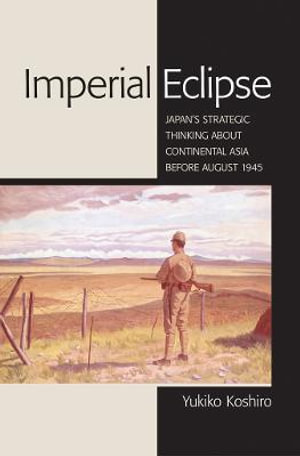
The "Pacific War" narrative of Japan's defeat that was established after 1945 started with the attack on Pearl Harbor, detailed the U.S. island-hopping campaigns across the Western Pacific, and culminated in the atomic bombings of Hiroshima and Nagasaki, Japan's capitulation, and its recasting as the western shore of an American ocean. But in the decades leading up to World War II and over the course of the conflict, Japan's leaders and citizens were as deeply concerned about continental Asia-and the Soviet Union, in particular-as they were about the Pacific theater and the United States. In Imperial Eclipse, Yukiko Koshiro reassesses the role that Eurasia played in Japan's diplomatic and military thinking from the turn of the twentieth century to the end of the war.
Through unprecedented archival research, Koshiro has located documents and reports expunged from the files of the Japanese Cabinet, ministries of Foreign Affairs and War, and Imperial Headquarters, allowing her to reconstruct Japan's official thinking about its plans for continental Asia. She brings to light new information on the assumptions and resulting plans that Japan's leaders made as military defeat became increasingly certain and the Soviet Union slowly moved to declare war on Japan (which it finally did on August 8, two days after Hiroshima). She also describes Japanese attitudes toward Russia in the prewar years, highlighting the attractions of communism and the treatment of Russians in the Japanese empire; and she traces imperial attitudes toward Korea and China throughout this period. Koshiro's book offers a balanced and comprehensive account of imperial Japan's global ambitions.
The "Pacific War" narrative of Japan's defeat that was established after 1945 started with the attack on Pearl Harbor, detailed the U.S. island-hopping campaigns across the Western Pacific, and culminated in the atomic bombings of Hiroshima and Nagasaki, Japan's capitulation, and its recasting as the western shore of an American ocean. But in the decades leading up to World War II and over the course of the conflict, Japan's leaders and citizens were as deeply concerned about continental Asia-and the Soviet Union, in particular-as they were about the Pacific theater and the United States. In Imperial Eclipse, Yukiko Koshiro reassesses the role that Eurasia played in Japan's diplomatic and military thinking from the turn of the twentieth century to the end of the war.Through unprecedented archival research, Koshiro has located documents and reports expunged from the files of the Japanese Cabinet, ministries of Foreign Affairs and War, and Imperial Headquarters, allowing her to reconstruct Japan's official thinking about its plans for continental Asia. She brings to light new information on the assumptions and resulting plans that Japan's leaders made as military defeat became increasingly certain and the Soviet Union slowly moved to declare war on Japan (which it finally did on August 8, two days after Hiroshima). She also describes Japanese attitudes toward Russia in the prewar years, highlighting the attractions of communism and the treatment of Russians in the Japanese empire; and she traces imperial attitudes toward Korea and China throughout this period. Koshiro's book offers a balanced and comprehensive account of imperial Japan's global ambitions.
Industry Reviews
"I highly recommended Imperial Eclipse to all serious students of World War II. Its use of Japanese sources is exemplary and helps remedy a conspicuous shortage of works focused on Japanese decision-making and the diverse perspectives present in its military and political leadership. Instructors teaching classes on the war in Asia, the end of WWII, and the beginning of the Cold War will also find this book important for its insight into the neglected Japanese view of events in Asia. "-Tyler Bramford, H-War(June 2014) "...Imperial Eclipse presents a bold interpretation of Japanese strategic thinking prior to the conclusion of World War II and is a book that should be read by any scholar interested in Japanese military history and foreign policy. Most importantly, this book provides us with an image of what Japan as a 'normal nation' could look like at a time when Japanese foreign policy is at a major turning point."-Reo Matsuzaki, The Journal of Northeast Asian History (Winter 2014) "In Imperial Eclipse, Yukiko Koshiro presents fresh evidence concerning Japanese relations with Russia and the Soviet Union from the nineteenth century to the end of World War II. The focus is on the war years, but there is a good deal of valuable material on the earlier decades. Koshiro shows that Russians were as much a presence in Japanese life as were Americans and other Europeans."-Akira Iriye, Charles Warren Research Professor of American History, Harvard University, author of The Origins of the Second World War in Asia and the Pacific "Good history is not a time line carved in stone. Japan did not inevitably become a willing American ally the day the Pacific War ended. This important book brings to light the postwar visions of Japan's wartime leaders. It is a 'revisionist' work in the best sense of that term."-Michael A. Barnhart, Distinguished Teaching Professor and Chair, Stony Brook University "Imperial Eclipse is a decisive recasting of the way we, in the West, tend to grasp Japan's geopolitical imaginary during World War II and its final stages. A salutary corrective to the typically U.S.-centered notion of a singular 'Pacific war' and the controversies of its atomic coda, Yukiko Koshiro's account establishes in no uncertain terms the Eurasian and colonial frame that was fundamentally at work. We will need to rethink."-Anders Stephanson, Andrew and Virginia Rudd Family Foundation Professor of History, Columbia University