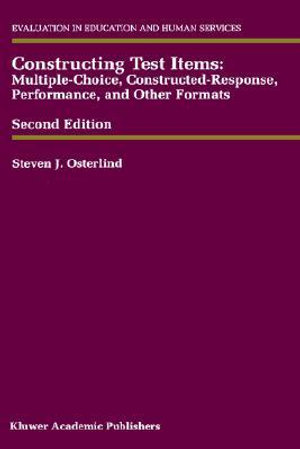
| What Is Constructing Test Items? | p. 1 |
| Introduction | p. 1 |
| What This Book Is About | p. 6 |
| Major Purposes Of This Book | p. 9 |
| Why This Information Is Important | p. 11 |
| Persons For Whom This Book Is Intended | p. 13 |
| Overview Of The Remaining Chapters | p. 14 |
| How To Approach the Chapters | p. 16 |
| Definition, Purpose, And Characteristics of Items | p. 17 |
| Introduction | p. 17 |
| Defining A Test Item | p. 19 |
| Test Item Nomenclature | p. 21 |
| Purpose For Test Items | p. 36 |
| Criteria For Good Test Items | p. 40 |
| Assumptions For Test Items | p. 44 |
| Classification Of Items | p. 54 |
| Conclusion | p. 57 |
| Determining the Content For Items: Validity | p. 59 |
| Introduction | p. 59 |
| Basic Concepts of Validity | p. 61 |
| The Relationship Between Constructing Test Items and Validity | p. 65 |
| Conditions For Items To Contribute To Validity | p. 67 |
| Initial Considerations When Selecting Content For Items | p. 69 |
| Achieving Clarity In A Test's Content | p. 71 |
| Melding Cognitive Processing Levels With Items Content | p. 83 |
| Test Item Specifications | p. 88 |
| Making An Item Consistent With Its Specification | p. 98 |
| Conclusion | p. 105 |
| Starting To Write Items: Practical Considerations | p. 107 |
| Introduction | p. 107 |
| The Importance Of Good Writing In Test Items | p. 109 |
| Sources For Information On Writing Style | p. 113 |
| The Computer and Writing Items | p. 115 |
| Using Taxonomies In Writing Items | p. 116 |
| Distinctness Between Stem and Response Alternatives | p. 132 |
| Importance Of An Interrogative Stem | p. 136 |
| Determining The Correct Response For Test Items | p. 139 |
| Positive Working in the Stem Rather than Negative | p. 145 |
| Determining The Optimal Number Of Response Alternatives | p. 146 |
| Making Response Alternatives Plausible | p. 148 |
| Use Of All Of The Above Or None Of The Above As Response Alternatives | p. 151 |
| Using Specific Determiners In Test Items | p. 155 |
| Constructing Complex Response Alternatives | p. 156 |
| Time Examinees Need To Respond To Items | p. 158 |
| Conclusion | p. 158 |
| Style, Editorial, and Publication Guidelines For Items in the Multiple-Choice Format | p. 161 |
| Introduction | p. 161 |
| Understanding The Multiple-Choice Item Format | p. 162 |
| Advantages and Criticisms Of Items In The Multiple-Choice Format | p. 163 |
| Editorial Format For Items | p. 165 |
| Using Directions Correctly | p. 169 |
| Specialized Style Rules For Multiple-Choice Items | p. 174 |
| Type Characteristics and Page Layout | p. 193 |
| Conclusion | p. 202 |
| Style, Editorial, and Publication Guidelines For Items in Constructed-Response and Performance Formats | p. 203 |
| Introduction | p. 203 |
| Types of Constructed-Response and Performance | p. 205 |
| Validity in Constructed-Response | p. 206 |
| Precision in Wording, Again | p. 208 |
| Conclusion | p. 214 |
| Style, Editorial, and Publication Guidelines For Items in Other Common Formats | p. 215 |
| Introduction | p. 215 |
| Precision In Wording, Again | p. 216 |
| Understanding Items In The True-False Format | p. 219 |
| Understanding Items In The Matching Format | p. 234 |
| Understanding Short-Answer And Sentence-Completion Items | p. 237 |
| Understanding Cloze-Procedure | p. 242 |
| Conclusion | p. 251 |
| Judging the Quality Of Test Items: Item Analysis | p. 253 |
| Introduction | p. 253 |
| Measurement Error | p. 254 |
| Understanding Item Analysis | p. 257 |
| Validating The Content Of Items | p. 258 |
| Using Leading Questions In Item Analysis | p. 265 |
| Item Statistics | p. 266 |
| Item Parameters | p. 284 |
| Item Bias | p. 289 |
| Conclusion | p. 298 |
| Ethical, Legal Considerations, and Final Remarks for Item Writers | p. 301 |
| Introduction | p. 301 |
| Ethical Concerns For Item Writers | p. 302 |
| Concluding Comments About Constructing Test Items | p. 308 |
| References | p. 311 |
| Author Index | p. 327 |
| Subject Index | p. 331 |
| Table of Contents provided by Syndetics. All Rights Reserved. |