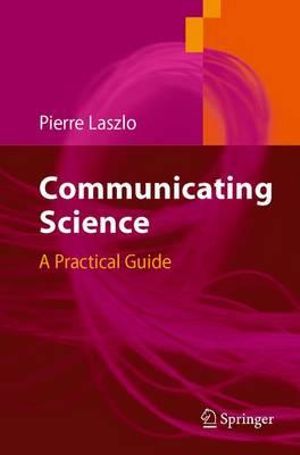
Communicating Science : A Practical Guide :  A Practical Guide - Pierre Laszlo

Communicating Science : A Practical Guide

A Practical Guide

By: Pierre Laszlo

Paperback | 1 January 2006

Sorry, we are not able to source the book you are looking for right now.

We did a search for other books with a similar title, however there were no matches. You can try selecting from a similar category, click on the author's name, or use the search box above to find your book.

Have you new and interesting, or even outstanding, scientific results that you want to be recognized by your scientific colleagues, or be understood by the public? Or do you want to address decision makers to change their minds? Then, Laszlo's Communicating Science may be the book to consult.

It has two main parts, corresponding to the type of communication task at hand: addressing peers and the general public, plus a third briefer section on how to inform decision-makers.

Each of the main parts is subdivided into two sections, Guidelines and Genres, with entries arranged in alphabetical order. The guidelines are devoted to entries such as acronyms, active or passive voice, body language, figures and captions, introduction, irony, and taking the floor. Within genres, all possible media of communicating science are treated, e.g. the after-dinner speech, conference presentation, keynote lecture, magazine article, research proposal, and teleconference.

Laszlo, a professional scientist, had a career embracing both academia and industrial consulting. He has extensive experience in authoring and editing papers, books and popular science books and conveys his skills as a communicator in this concise guide. The book is geared to engineers and scientists, educators and journalists, science administrators and the medical profession, editors and publishers, whether native or non-native-speakers - in short to anyone having to convert scientific data into an easily intelligible and interesting narrative.

Industry Reviews

From the reviews:

"Pierre Laszlo, emeritus professor of chemistry at the Ecole polytechnique and the University of Liege, has been keeping notes - and not just on organic syntheses. A prolific author of essays, books and plays as well as scholarly articles, Laszlo knows a thing or two about the challenging but central aspect of science called communcation - and like a good chemist, he has now collected and published his notes in a manual. Communicating Science is a handbook for the helpless scientist. It is organized for emergency use; there's even a quick index in the back with entries such as "accessories: glass of water" and "how to: deal with hecklers." In his coverage of topics ranging from technical writing to media interviews, Laszlo conveys a life-time of experience in advice both pithy and provocative. I cannot argue with his taste: He holds up American Scientist essayists as models and urges scientists to get along with editors. And he would approve of the type conveying these words to you. Serifs, he notes, "are the small slippers which letters bear on their feet." To keep the viewer's eye moving along the type in a slide presentation, Laszlo would forgo sans serif fonts, "however sexy they may look," and supply slippers."

from: Rosalind Reid in American Scientist, March-April 2007 issue

"The content takes a commendably wide-ranging view of communication, embracing the after-dinner speech, conference presentation, keynote lecture, magazine article, research proposal, press release and obituary. Laszlo is a professional scientist ... . he allows this knowledge and experience of the field to shine through, and this is when the book is at its best, written in a style which is entertaining and engaging. ... Overall, the book contains some useful tips that could point the novice science communicator in the right direction ... ." (Sue Assinder, Microiology Today, June, 2007)

"This book consists ofthree parts, corresponding to the different audiences to which scientists might wish to communicate their science: peer scientists, the general public, and decision-makers in politics, business, and courtrooms. ... Laszlo provides, in alphabetical order, general guidelines for content preparation, interaction with the audiences, and general conduct, and then a discussion of different genres of science communication. ... The guidelines are written for individual fellow scientists and science students ... ." (Joachim Schummer, Ambix, Vol. 57 (1), March, 2010)

More in Biology, Life Sciences

Liars, cheats and copycats : Trickery and deception in nature - James O'Hanlon
Nature Boy : A journey of birdsong and belonging - Sean Ronayne

RRP $34.99

$28.75

18%
OFF
Heart of Ice : A journey into Antarctica's frozen realm - Joy McCann
Principles of Anatomy and Physiology : 3rd Asia Pacific Edition - Gerard J. Tortora
Mushrooms : A Guide For the Curious - Susan E. Clark

RRP $19.99

$16.99

15%
OFF
Birds of Western Australia : 2nd Edition - The Field Guide - Simon Nevill
The Anatomy Coloring Book - Wynn Kapit

RRP $33.55

$29.75

11%
OFF
Anatomy & Physiology For Dummies : For Dummies - Erin Odya

RRP $38.95

$26.75

31%
OFF
Netter's Anatomy Coloring Book : 3rd edition - John T. Hansen

RRP $39.95

$34.75

13%
OFF
Arid Shrubland Plants : of Western Australia, third edition - Andrew Mitchell
Planet Fungi : A Photographer's Foray - Catherine Marciniak

RRP $59.99

$47.75

20%
OFF
A Field Guide to Australian Fungi - Bruce Fuhrer

RRP $49.95

$38.75

22%
OFF
AFN Australian Fish Guide : AFN Fish ID - Frank Prokop

RRP $29.99

$24.99

17%
OFF
Field Guide to the Native Plants of Sydney - Les Robinson

RRP $59.99

$39.75

34%
OFF