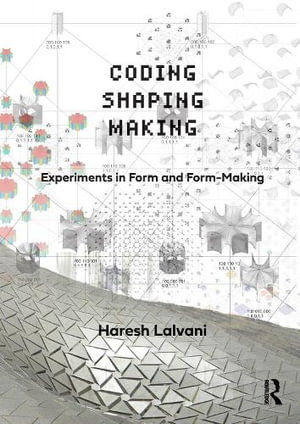
'We see in the history of science the laying down of foundational elements before a new paradigm bursts forth. Thus the work of Copernicus, Brahe, Kepler, and Galileo preceded Newtonian mechanics. And the Michelson-Morley measurements, the Lorentz transformations, and Poincare's mathematics proceeded Einstein's relativity.
We are today again in such a moment as a new paradigm is emerging, generative morphogenetics, the unfolding of form from simple rules,,,.Lalvani's Coding, Shaping, Making: Experiments in Form and Form-Making is a foundational work underlying [this] emerging field....As such it joins D''Arcy Thompson's growth and form, John Archibald Wheeler's it from bit, David Deutsch's constructor theory, Stephen Wolfram's new kind of science, and Neil Gershenfeld's information in the material.
To put it simply, Lalvani asks...are there fundamental morphological principles at work that we do not yet fully understand? Lalvani contends that there are, and he explores them.
Lalvani's work has implications for important new developments in morphology, mathematics, logic, chemistry, biology, evolutionary theory, nanotechnology, digital fabrication among many other fields. I believe researchers in numerous fields will mine his work for new avenues of understanding for decades to come.
Stephen Wolfram says, "I think when I find the code that generates our world, it will be about six lines." Lalvani brings us hints of that code.' - John Lobell, Professor of Architecture, Pratt Institute
'Lalvani's ground-breaking concept of 'Morphological Universe' included in this book....captures the most original aspects of his work in design science. What he has done is amazing. I believe it to be a grand unification of what others have done in small pieces. It is astounding to see it all come together masterfully in a beautifully visual representation which is also theoretically mathematical.
I would say that transformation is the key to Lalvani's approach. Nothing is a single incident... the value of a taxonomy of form such as Lalvani's Morphological Universe is in its applications which he demonstrates masterfully in both beautiful diagrams as well as his physical experiments with materials. He likens this work to a kind of DNA of form....in which by inputting a code of numbers he is able to call up a wide variety of forms which are then capable of fabrication in physical materials. This is a new way to create both art, and industrial design.
...he has carried out experiments in which the surfaces shape themselves under a force...This self-shaping is a new principle of morphogenesis.
....Lalvani continues to integrate yet more material into his system. And it is the very notion of a system behind all of these forms which appears not only in geometry and design but in other fields such as biology, geology, botany and perhaps even particle physics, that is his real contribution through these efforts.' - Jay Kappraff, Emeritus Associate Professor of Mathematics, New Jersey Institute of Technology
'Throughout history, we find a distinguished list of visionaries, seeking to bring clarity and reason to the unknown. The perpetual search for the underlying order that governs our complex universe has captivated our imagination and drawn them toward a life of speculative inquiry.
Haresh Lalvani has devoted his entire life to unveiling a morphological genome. Captivated by the vast diversity of shape grammar that underpins the natural and man-made world, he tirelessly pursues research that reveals a universal system of codes capable of producing an infinite alphabet of spatial morphological configurations. Envisioned as a massive periodic table cataloging each incremental modification in emerging growth his findings unveil an expansive evolutionary network undergoing continuous change.
His groundbreaking research, prominently presented in his book Coding Shaping Making, holds the key to the future of genomic architecture. Imagined as an auto-morphogenetic turning point in history, Haresh dreams of a time when all matter will act as generative geometry, encoding information in real time to reshape its very own existence. It is a glorious view of our rapidly changing new world and reaffirms his status as one of the great visionaries in our profession today.'
Evan Douglis, Dean, School of Architecture, Rensselaer Polytechnic Institute (RPI)
'Higher-dimensional worlds are rich with extraordinary shapes, many of which remain unknown to us. These may move around, transform, shrink and grow, taking the form of curved surfaces or polyhedral shapes designed with colorful periodic or aperiodic patterns. However, we cannot directly see any of these fascinating forms. Dr. Haresh Lalvani's luxurious and timely book Coding Shaping Making uncovers the potential practicalities of these shapes and drawings by visual multi-dimensional geometry and profound original theory. It covers numerous aspects of art and science, the micro and macrocosm, Euclidean and non-Euclidean space, organic and inorganic beings and much more. Furthermore, in order to render these concepts and shapes more approachable, the author makes lavish use of a bevy of remarkable computer graphics and videos. Consequently, the book feels more like a beautiful picture book of unfamiliar puzzles or a mysterious story. The story may not attain even now. The author must have many other original ideas, waiting to be compiled in new books and we are excited to see those ideas realized practically as architecture in the near future.'
Koji Miyazaki, Dr. Eng., Architect, Professor Emeritus, Kyoto University, Japan
'We see in the history of science the laying down of foundational elements before a new paradigm bursts forth. Thus the work of Copernicus, Brahe, Kepler, and Galileo preceded Newtonian mechanics. And the Michelson-Morley measurements, the Lorentz transformations, and Poincare's mathematics proceeded Einstein's relativity.
We are today again in such a moment as a new paradigm is emerging, generative morphogenetics, the unfolding of form from simple rules,,,.Lalvani's Coding, Shaping, Making: Experiments in Form and Form-Making is a foundational work underlying [this] emerging field....As such it joins D''Arcy Thompson's growth and form, John Archibald Wheeler's it from bit, David Deutsch's constructor theory, Stephen Wolfram's new kind of science, and Neil Gershenfeld's information in the material.
To put it simply, Lalvani asks...are there fundamental morphological principles at work that we do not yet fully understand? Lalvani contends that there are, and he explores them.
Lalvani's work has implications for important new developments in morphology, mathematics, logic, chemistry, biology, evolutionary theory, nanotechnology, digital fabrication among many other fields. I believe researchers in numerous fields will mine his work for new avenues of understanding for decades to come.
Stephen Wolfram says, "I think when I find the code that generates our world, it will be about six lines." Lalvani brings us hints of that code.'
John Lobell, Professor of Architecture, Pratt Institute
'Lalvani's ground-breaking concept of 'Morphological Universe' included in this book....captures the most original aspects of his work in design science. What he has done is amazing. I believe it to be a grand unification of what others have done in small pieces. It is astounding to see it all come together masterfully in a beautifully visual representation which is also theoretically mathematical.
I would say that transformation is the key to Lalvani's approach. Nothing is a single incident... the value of a taxonomy of form such as Lalvani's Morphological Universe is in its applications which he demonstrates masterfully in both beautiful diagrams as well as his physical experiments with materials. He likens this work to a kind of DNA of form....in which by inputting a code of numbers he is able to call up a wide variety of forms which are then capable of fabrication in physical materials. This is a new way to create both art, and industrial design.
...he has carried out experiments in which the surfaces shape themselves under a force...This self-shaping is a new principle of morphogenesis.
....Lalvani continues to integrate yet more material into his system. And it is the very notion of a system behind all of these forms which appears not only in geometry and design but in other fields such as biology, geology, botany and perhaps even particle physics, that is his real contribution through these efforts.'
Jay Kappraff, Emeritus Associate Professor of Mathematics, New Jersey Institute of Technology