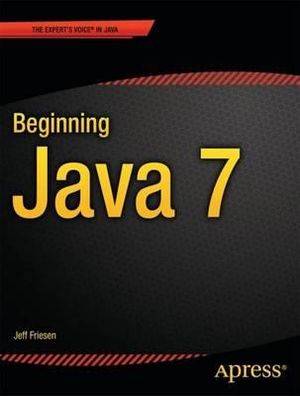
Beginning Java 7 guides you through this language and a huge assortment of platform APIs according to the following table of contents:
Chapter 1: Getting Started with Java Chapter 2: Discovering Classes and Objects Chapter 3: Exploring Advanced Language Features Chapter 4: Touring Language APIs Chapter 5: Collecting Objects Chapter 6: Touring Additional Utility APIs Chapter 7: Creating and Enriching Graphical User Interfaces Chapter 8: Interacting with Filesystems Chapter 9: Interacting with Networks and Databases Chapter 10: Parsing, Creating, and Transforming XML Documents Chapter 11: Working with Web Services Chapter 12: Focusing on Security Chapter 13: Java 7 Meets Android Appendix A: Solutions to Exercises Appendix B: Scripting API and Dynamically Typed Language Support Appendix C: Odds and Ends
Chapter 1 introduces you to Java and begins to cover the Java language by focusing on fundamental concepts such as comments, identifiers, variables, expressions, and statements.
Chapter 2 continues to explore this language by presenting all of its features for working with classes and objects. You learn about features related to class declaration and object creation, encapsulation, information hiding, inheritance, polymorphism, interfaces, and garbage collection.
Chapter 3 focuses on the more advanced language features related to nested classes, packages, static imports, exceptions, assertions, annotations, generics, and enums. Additional chapters will introduce you to the few features not covered in Chapters 1 through 3.
Chapter 4 largely moves away from covering language features (although it does introduce class literals and strictfp) while focusing on language-oriented APIs. You learn about Math, StrictMath, Package, Primitive Type Wrapper Classes, Reference, Reflection, String, StringBuffer and StringBuilder, Threading, BigDecimal, and BigInteger in this chapter.
Chapter 5 begins to explore Java's utility APIs by focusing largely on the Collections Framework. However, it also discusses legacy collection-oriented APIs and how to create your own collections.
Chapter 6 continues to focus on utility APIs by presenting the concurrency utilities along with the Objects and Random classes.
Chapter 7 moves you away from the command-line user interfaces that appear in previous chapters and toward graphical user interfaces. You first learn about the Abstract Window Toolkit foundation, and then explore the Java Foundation Classes in terms of Swing and Java 2D. Appendix C explores Accessibility and Drag and Drop.
Chapter 8 explores filesystem-oriented I/O in terms of the File, RandomAccessFile, stream, and writer/reader classes.
Chapter 9 introduces you to Java's network APIs, such as sockets. It also introduces you to the JDBC API for interacting with databases.
Chapter 10 dives into Java's XML support by first presenting an introduction to XML (including DTDs and schemas). It next explores the SAX, DOM, StAX, XPath, and XSLT APIs. It even briefly touches on the Validation API. While exploring XPath, you encounter namespace contexts, extension functions and function resolvers, and variables and variable resolvers.
Chapter 11 introduces you to Java's support for SOAP-based and RESTful web services. In addition to providing you with the basics of these web service categories, Chapter 11 presents some advanced topics, such as working with the SAAJ API to communicate with a SOAP-based web service without having to rely on JAX-WS. You will appreciate having learned about XML in Chapter 10 before diving into this chapter.
Security is a very important part of today's world and Java doesn't let you down in this area. Chapter 12 introduces you to Java's support for security in terms of virtual machine-oriented APIs and encryption/authentication.
Now that you have gained a huge overview of what Java has to offer in terms of its language and APIs, you might want to put some of this knowledge to use by using Java to write an Android app's source code.
Chapter 13 helps you meet this objective by introducing you to Android, discussing its architecture, showing you how to install necessary tools, developing a simple app, and presenting a few miscellaneous (but need to know) items.
Each of Chapters 1 through 13 ends with an exercises section that presents a few programming exercises.
Appendix A presents the solutions to these exercises.
Appendix B introduces you to Java's Scripting API along with Java 7's support for dynamically typed languages.
Although Chapters 1 through 13 gave you a huge overview of Java APIs, there is still much to learn. For this reason, Appendix C walks you through many additional APIs, such as ClassLoader, New I/O, SplashScreen, Internationalization, and even the Java Native Interface.
Unfortunately, there are limits to how much knowledge can be crammed into a print book. For this reason, Appendixes A, B, and C are not included in this book's pages. Instead, they are freely distributed as PDF files bundled with the book's associated code file at the Apress website (apress.com).
What you'll learn
- The entire Java language, including Java 7-specific features such as switch on string, try-with-resources, final rethrow, multicatch, and SafeVarargs
- A huge assortment of Java 7 APIs, beginning with those APIs oriented toward the language itself, and including Java 7-specific APIs such as the Fork/Join Framework, Objects, JLayer, and NIO.2
- Various Java 7 tools, starting with the javac compiler and java application launcher
- How to create user interfaces, working with web services, and a whole lot more
- The basics of getting started with Android app development