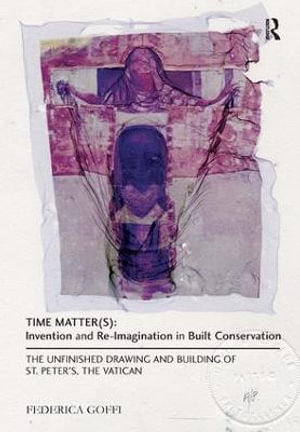
Even though the idea of altering an existing building is now a well-established and well received practice within the context of contemporary adaptive reuse, when the building in question is a 'mnemic building', of recognized heritage value, alterations are viewed with suspicion, even when change is a recognized necessity. This book fills in a blind spot in current architectural theory and practice, looking into a notion of conservation as a form of invention and imagination, offering the reader a counter-viewpoint to a predominant western understanding that preservation should be a 'still shot' from the past. Through a micro-historical study of a Renaissance concept of restoration, this book provides a theoretical framework to question the issue of change as a possible creative endeavour, when a mnemic building is concerned, entailing conservation of memory within changes. It focuses on Tiberio Alfarano's 1571 ichnography of St. Peter's Basilica in the Vatican, into which was woven a complex body of religious, political, architectural and cultural elements.
Alfarano created a track-drawing, providing memory traces on the drawing-site, which, acting like a veil, bear marks of the building's presence within time. By merging past and present temple's plans, he questioned the design pursued and opened the gaze towards other possible future imaginings. The drawing thus acts like a daydream, being a substratum for the imagination of conservation, realizing a real effigy. This book uncovers how the daydream drawing was acted on by Carlo Maderno (1556-1629), who literally used it as physical substratum to test his new design proposals for the addition of an eastern arm, completing the renewal of the temple in 1626.This study reveals a hybrid architectural-conservation approach, merging of the two practices, revealing their interdependence and reciprocity through a viewpoint / counter viewpoint questioning, which can be equally used in contemporary renovation projects. By creating such hybrid drawings, the retrospective and prospective character of architectural-conservation can be experienced and it is possible for new and old, past and present to form a continuous and contiguous reality.
Directing the gaze simultaneously in two directions, a pre-existent condition engages in dialogue with future design - architectural drawings could rejoin multiple temporalities, through metaphoric or literal transparency, and allow for a real transformation within continuity of identity. This concept might provide a paradigmatic and timely model to retune contemporary architectural sensibility when dealing with the dilemma between design and preservation in the process of transforming a building of recognized significance.
Industry Reviews
'Time Matter(s) is a unique and timely scholarly study of Tiberio Alfarano's mysterious drawing of St Peter's Basilica from the late 16th century, examining the work in the context of the temporality of building conveyed through the symbolic inter-relationships between the old and new basilicas. The drawing is unique in simultaneously depicting the building as both a 'receptacle' of memory (in regard to the historical developments and adaptations of the original Constantinian basilica) and as an anticipatory expression of the completed new basilica, which at the time was still under construction. Understood more as a sacred artifact than a mere drawn depiction, the representation reveals much about the relationship between conserving the past and creating a new architectural order, which the author examines with great acumen and scholarly insight. At the same time, the author argues that the artifact provides a rich and fertile source of ideas about broader issues of building conservation today, providing a critical point of reference for re-evaluating the nature and meaning of historical and cultural continuity as a problem of architectural representation. The book would be of interest to both practitioners and academics, challenging conventional assumptions of an unmediated relationship between history and creativity that has become endemic in architectural conservation today.' Nicholas Temple, University of Huddersfield, UK 'This book is a ground-breaking event in the field and deals with materials that for some strange and unclear reasons have been completely overlooked in both the history of St. Peter's and within theories of historic conservation. The backbone of the book, the analysis of the Tiberio Alfarano's artifact is very exhaustive and far-reaching in singling out the cultural interaction between representations and buildings. The evaluation of Alfarano's unique facture is done with very sophisticated sensorial procedures and it will be an innovative contribution to scholarship of visual literacy and its role in the analyses and assessment of historical conservation. The book is also novel in the way it is structured and presents research that falls within a tradition of micro-history as a way to tackle the central questions regarding the temporality of the built environment. It also gives historical support to methods of study and action that can help to break the present bad habits of mummification that are employed unfortunately when dealing with the conservation of culturally loaded buildings.' Marco Frascari, Carleton University, Canada 'Time Matter(s) will sit well on many shelves: among histories of Renaissance architecture, studies of architectural representation, and theories of conservation. But it may stand most enduringly with (and against) books treating an even more fundamental if implicit architectural matter-the multivalent substance, subject and agency of time.' Journal of Architectural Education