

Get Free Shipping on orders over $89
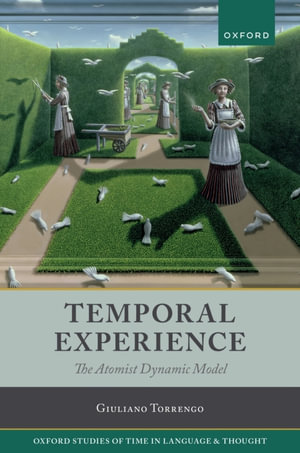
Temporal Experience : The Atomist Dynamic Model - Giuliano Torrengo

Temporal Experience

The Atomist Dynamic Model

By: Giuliano Torrengo

eText | 12 July 2024 | Edition Number 1

At a Glance

eText


$157.53

or 4 interest-free payments of $39.38 with

 or 

Instant online reading in your Booktopia eTextbook Library *

Why choose an eTextbook?

Instant Access *

Purchase and read your book immediately

Read Aloud

Listen and follow along as Bookshelf reads to you

Study Tools

Built-in study tools like highlights and more

* eTextbooks are not downloadable to your eReader or an app and can be accessed via web browsers only. You must be connected to the internet and have no technical issues with your device or browser that could prevent the eTextbook from operating.
Many physical theories suggest that time does not pass, yet temporality deeply permeates our experience. We perceive change and movement, we are aware of living in the present, of the constant flux of our sensations and thoughts, and of time itself flowing. In Temporal Experience, Torrengo considers the core facts of temporal experience and their interconnections, ultimately defending the atomist dynamic model of temporal experience. The book critically examines prevalent theories of experience of change, succession, and passage of time both in philosophy and psychology. Each chapter contributes to the construction of the atomist dynamic model. Experience of change and movement are explained through mental events that present virtually instantaneous movement and change. Torrengo challenges the common belief in the perception of 'presentness' and proposes an error theory based on narrative cognition. The experience of succession is elucidated through the concept of an overarching phenomenology, arguing against the tendency to overstate the phenomenal continuity of experience. Finally, the experience of the passage of time is approached through the non-representationalist theory of the phenomenal modifier, and the book concludes by discussing the surprising consequences of applying the experiential model defended to the scientific image of our existence in time as a sequence of physical events.
on
Desktop
Tablet
Mobile

More in Semantics & Discourse Analysis

How to Write a Sentence : And How to Read One - Stanley Fish

eBOOK

Burn This Book : Notes on Literature and Engagement - Toni Morrison

eBOOK

The Art Of Rhetoric - Aristotle

eBOOK