

Get Free Shipping on orders over $79
Statistical Decision Problems : Selected Concepts and Portfolio Safeguard Case Studies - Michael Zabarankin

Statistical Decision Problems

Selected Concepts and Portfolio Safeguard Case Studies

By: Michael Zabarankin, Stan Uryasev

eText | 16 December 2013

At a Glance

eText


$84.99

or 4 interest-free payments of $21.25 with

 or 

Instant online reading in your Booktopia eTextbook Library *

Why choose an eTextbook?

Instant Access *

Purchase and read your book immediately

Read Aloud

Listen and follow along as Bookshelf reads to you

Study Tools

Built-in study tools like highlights and more

* eTextbooks are not downloadable to your eReader or an app and can be accessed via web browsers only. You must be connected to the internet and have no technical issues with your device or browser that could prevent the eTextbook from operating.

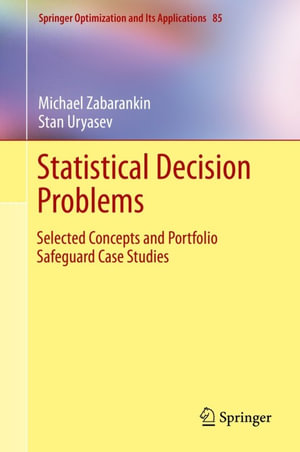
Statistical Decision Problems presents a quick and concise introduction into the theory of risk, deviation and error measures that play a key role in statistical decision problems. It introduces state-of-the-art practical decision making through twenty-one case studies from real-life applications. The case studies cover a broad area of topics and the authors include links with source code and data, a very helpful tool for the reader. In its core, the text demonstrates how to use different factors to formulate statistical decision problems arising in various risk management applications, such as optimal hedging, portfolio optimization, cash flow matching, classification, and more.

The presentation is organized into three parts: selected concepts of statistical decision theory, statistical decision problems, and case studies with portfolio safeguard. The text is primarily aimed at practitioners in the areas of risk management, decision making, and statistics. However, the inclusion of a fair bit of mathematical rigor renders this monograph an excellent introduction to the theory of general error, deviation, and risk measures for graduate students. It can be used as supplementary reading for graduate courses including statistical analysis, data mining, stochastic programming, financial engineering, to name a few. The high level of detail may serve useful to applied mathematicians, engineers, and statisticians interested in modeling and managing risk in various applications.

on
Desktop
Tablet
Mobile

More in Operational Research

Logistics Handbook - James F. Robeson

eBOOK

Shaping Collaborative Ecosystems for Tomorrow - Igor Perko

eBOOK

Current Issues in Accounting - Niyazi Kurnaz

eBOOK

RRP $143.95

$129.99

10%
OFF
Operations Management - Steven Bragg

eBOOK