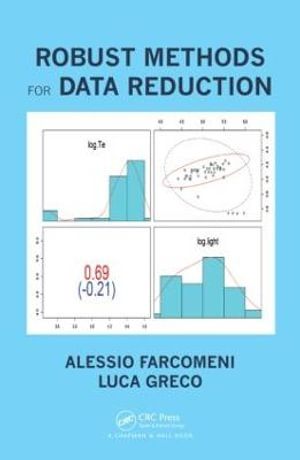
"... this book tries to avoid technicalities and focuses on illustrating the power of robust techniques in action. Additionally, it covers some novel techniques, involving data reduction ... An important concept addressed in Part 2 of the book is independent cell-wise contamination. A large number of variables and a relatively small number of cases are commonplace in modern statistical applications. ... The proposed snipping methodology is tailored to be applied in the presence of cell-wise contamination, and from my point of view, is one of the principal methodological contributions of the book. ...
In summary, this book is interesting and useful. The book is not an attempt to systematically review all the literature in robust data reduction. However, it proposes a selection of techniques that are simple to understand or to use in practice."
-Luis Angel Garcia Escudero, Dpto. de Estadistica e I. O., Universidad de Valladolid, in Biometrics, June 2017
"'Robust Methods for Data Reduction' makes it easy for practitioners of big-data analytics to conduct robust and efficient data reduction. It is a timely topic in which recently prescribed algorithms and methodological research findings are properly assimilated and presented in a lucid fashion. The book serves as a good introductory book that motivates and teaches the art of developing robust frameworks for synthesis and reduction of large, complex datasets...The most appealing aspect of this book is that all of the concepts and algorithms described are inspired by real-data examples. All of the methods presented in this book are accompanied by extensive codes and exhaustive documentation on how to implement them in the R computing environment. Readers can download the data and the computer code used in the book from the publisher's webpage...The collection of data examples and the pedagogical writing style make it an ideal text for instructors aiming to quickly train students on proper data-reduction techniques...This book will be particularly useful for courses with R labs. It is bound to find a wide and enduring readership and will be a valuable addition to the library of any data scientist."
-Gourab Mukherjee, University of Southern California, in Journal of the American Statistical Association, Volume 111, 2016
"... this book tries to avoid technicalities and focuses on illustrating the power of robust techniques in action. Additionally, it covers some novel techniques, involving data reduction ... An important concept addressed in Part 2 of the book is independent cell-wise contamination. A large number of variables and a relatively small number of cases are commonplace in modern statistical applications. ... The proposed snipping methodology is tailored to be applied in the presence of cell-wise contamination, and from my point of view, is one of the principal methodological contributions of the book. ...
In summary, this book is interesting and useful. The book is not an attempt to systematically review all the literature in robust data reduction. However, it proposes a selection of techniques that are simple to understand or to use in practice."
-Luis Angel Garcia Escudero, Dpto. de Estadistica e I. O., Universidad de Valladolid, in Biometrics, June 2017
"'Robust Methods for Data Reduction' makes it easy for practitioners of big-data analytics to conduct robust and efficient data reduction. It is a timely topic in which recently prescribed algorithms and methodological research findings are properly assimilated and presented in a lucid fashion. The book serves as a good introductory book that motivates and teaches the art of developing robust frameworks for synthesis and reduction of large, complex datasets...The most appealing aspect of this book is that all of the concepts and algorithms described are inspired by real-data examples. All of the methods presented in this book are accompanied by extensive codes and exhaustive documentation on how to implement them in the R computing environment. Readers can download the data and the computer code used in the book from the publisher's webpage...The collection of data examples and the pedagogical writing style make it an ideal text for instructors aiming to quickly train students on proper data-reduction techniques...This book will be particularly useful for courses with R labs. It is bound to find a wide and enduring readership and will be a valuable addition to the library of any data scientist."
-Gourab Mukherjee, University of Southern California, in Journal of the American Statistical Association, Volume 111, 2016