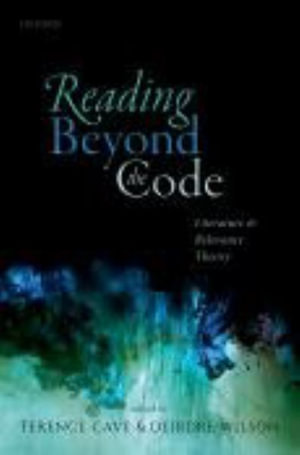
This book explores the value for literary studies of the model of communication known as relevance theory. Drawing on a wide range of examples-lyric poems by Yeats, Herrick, Heaney, Dickinson, and Mary Oliver, novels by Cervantes, Flaubert, Mark Twain, and Edith Wharton-nine of the ten essays are written by literary specialists and use relevance theory both as a broad framing perspective and as a resource for detailed analysis. The final essay, by Deirdre Wilson, co-founder (with Dan Sperber) of relevance theory, takes a retrospective view of the issues addressed by the volume and considers the implications of literary studies for cognitive approaches to communication. Relevance theory, described by Alastair Fowler as 'nothing less than the makings of a radically new theory of communication, the first since Aristotle's', offers a comprehensive pragmatics of language and communication grounded in evidence about the ways humans think and behave. While designed to capture the
everyday murmur of conversation, gossip, peace-making, hate speech, love speech, 'body-language', and the chatter of the internet, it covers the whole spectrum of human modes of communication, including literature in the broadest sense as a characteristically human activity.
Reading Beyond the Code is unique in using relevance theory as a prime resource for literary study, and it is also the first to claim that the model works best for literature when understood in the light of a broader cognitive approach, focusing on a range of phenomena that support an 'embodied' conception of cognition and language. This broadened perspective serves to enhance the value for literary studies of the central claim of relevance theory, that the 'code model' is fundamentally inadequate to account for human communication, and in particular for the modes of communication that are proper to literature.
Industry Reviews
...the important contribution this volume makes to the understanding of relevance theory and its relation to literary interpretation. It shows explicitly what relevance theory shares with other cognitive approaches and how it differs. In respecting the power of literary language as ostensive performance, it invites rather than imposes interpretative strategies that inform the best of literary criticism. * Margaret H. Freeman, Myrifield Institute for Cognition and the Arts, Modern Language Review *
To what extent do the principles of a theory of spontaneous face-to-face communication carry over to the interpretation of carefully crafted literary texts (novels, plays, poems)? That is the central question addressed by this book. The literary studies presented here are deeply informed by Relevance Theory's cognitive-inferential account of communication while remaining acutely alert to the sensorimotor, kinesic, affective and other non-propositional effects that a work of literature may have on a receptive reader. This engaging set of essays is for students of literature, communication theorists, and anyone who has ever marvelled at the rich experience of reading fiction. * Robyn Carston, University College London *
Dan Sperber and Deirdre Wilson's Relevance: Communication and Cognition (1986) revolutionized the understanding of communication: they showed it to depend not simply on decoding, but on selecting optimally relevant results. Reading Beyond the Code, edited by Terence Cave and Deirdre Wilson, now takes up the same relevance theory and applies it to literature. Again the outcome is an important contribution. * Alastair Fowler, Professor Emeritus, University of Edinburgh *
The relevance of 'Relevance' to literary understanding was clear from Sperber and Wilson's inauguration of the concept. After literary theory's long wanderings in the wilderness, it brought literary studies back to the conditions of everyday life and thought. Its claims have since been strengthened by interaction with cognitive science and a three-year Balzan research programme. As a sequel, the present essay collection shows how subtly the central idea has been developed and how fruitfully it can be applied to a wide range of texts and genres. * T. J. Reed, Taylor Professor Emeritus of the German Language and Literature, Oxford *