Probability Models for DNA Sequence Evolution
By: Richard Durrett
Hardcover | 12 August 2008 | Edition Number 2
At a Glance
444 Pages
Revised
22.86 x 15.88 x 2.54
Hardcover
$279.00
or 4 interest-free payments of $69.75 with
orShips in 5 to 7 business days
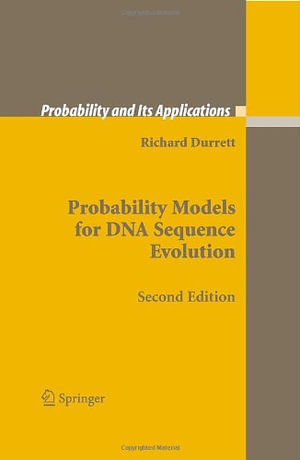
Our basic question is: Given a collection of DNA sequences, what underlying forces are responsible for the observed patterns of variability? To approach this question we introduce and analyze a number of probability models: the Wright-Fisher model, the coalescent, the infinite alleles model, and the infinite sites model. We study the complications that come from nonconstant population size, recombination, population subdivision, and three forms of natural selection: directional selection, balancing selection, and background selection. These theoretical results set the stage for the investigation of various statistical tests to detect departures from "neutral evolution". The final chapter studies the evolution of whole genomes by chromosomal inversions, reciprocal translocations, and genome duplication.
Throughout the book, the theory is developed in close connection with data from more than 60 experimental studies from the biology literature that illustrate the use of these results. This book is written for mathematicians and for biologists alike. We assume no previous knowledge of concepts from biology and only a basic knowledge of probability: a one semester undergraduate course and some familiarity with Markov chains and Poisson processes.
Industry Reviews
From the reviews:
This book serves as an introduction to, and a compilation of, results in the new and growing field of probability theory for DNA evolution. The author is a probabilist, but he has made an effort to appeal to biologists and mathematicians alike. Biologists will find in this book those methods used for studying DNA variability that go beyond straightforward applications of statistics and require genuine mathematical insight into the underlying mechanisms. The example data are real and the driving motivation is to understand these truthfully. Mathematicians will find in this book not an attempt to develop some abstract theory, but rather a kaleidoscopic collection of ideas and methods invented to attack a common problem. The emphasis is on catching the main ideas in down-to-earth calculations; continuum models and more sophisticated methods from analysis are avoided. The book starts with the Wright-Fisher model for neutral selection in a constant population, and then builds and varies on this in Chapters 1--3 by adding the effects of mutation, recombination, selection, nonconstant population sizes and spatial structure. Chapter 4 is devoted to statistical tests for detecting departures from the neutral model and Chapter 5 discusses the large-scale structure of the DNA such as the size and number of chromosomes, inversions, translocations and duplications. This book will serve as a useful guide to this new and exciting field and an inspiration even for the more experienced readers.--Mathematical Reviews
"With numerous interspersed example datasets from the primary literature, this book offers a brief introduction to models of both long-term and short-term DNA sequence evolution, with emphasis on the latter...Diverse audiences will find much of the value in this concise book. The author's rigor and ability to embed material in a broader mathematical context will appeal to quantitative readers with little background inbiology...The book's strength is in its mathematical content, which revives almost-forgotten theorems, includes new proofs, and is thorough but not overwhelmingly detailed or overburdened with notation."Journal of the American Statistical Association, June 2004
From the reviews of the second edition:
"This book may be considered as a monograph on probability modeling DNA sequence evolution. It also can be considered as reference book fro researchers in the theme. ... The book introduces the particularities of the modeling for special an important families of problems arising in the study of DNA. ... it is good book for mathematicians, biologists, physics, engineers and other scientists involved with the study of DNA problems." (Chou-la kain, Revista Investigacion Operacional, Vol. 30 (2), 2009)
"The highly acclaimed book ... by Richard Durrett also continues to be successful in the second edition. The book discusses probability models for population genetics focusing on analytical results and their proofs. ... A number of numerical examples and graphs are given to aid the reader's comprehension. ... The book can be highly recommended to all graduate students and researchers involved in interdisciplinary work in the field of mathematics and biology who are interested in genetics and evolution from a mathematical point of view." (Manuel Dehnert, Biometrical Journal, Vol. 51 (3), 2009)
"This is the second edition of the author's book ... . One of its main aims is to build a bridge between biologists on the one hand, and mathematicians ... on the other hand. ... this edition has expanded a lot, almost doubling in size. This is mainly due to the fact that a lot of material has been added. ... One of the strong points of the book is that it is an excellent guide to the literature, collecting over 400 references ... ." (Jan M. Swart, Mathematical Reviews, Issue 2009 k)
"The previous edition of this book was published in 2002 andreviewed in Biometrics 59, 206. The reviewer, David Balding, concluded that 'Both the mathematician looking for an introduction to applications in genetics, and the biologist needing more insight into the mathematical foundations of population genetics and evolution, will find much of interest here.' Those people will find even more of interest in this new edition, which is about 75% larger than the original. The expansion incorporates both an increase in the range of topics covered and an update in light of recent work." (Biometrics, Summer 2009, 65, 1000)
"This book would be appropriate for advanced graduate students in probability and mathematical statistics with interests in genetics. ... the goal of the book is to present 'useful analytic results in population genetics, together with their proofs.' ... The literature review is excellent and it is intertwined with the text. ... The book is up-to-date as evidenced by the references. ... For statisticians or probability specialists ... this book is excellent. ... In conclusion, I highly recommend the book." (Myron Hlynka, Technometrics, Vol. 51 (4), November, 2009)

| Preface | p. V |
| Basic Models | p. 1 |
| ATGCs of life | p. 1 |
| Wright-Fisher model | p. 5 |
| The coalescent | p. 8 |
| Shape of the genealogical tree | p. 11 |
| Infinite alleles model | p. 14 |
| Hoppe's urn, Ewens' sampling formula | p. 15 |
| Chinese restaurants and sufficient statistics | p. 20 |
| Branching process viewpoint | p. 26 |
| Infinite sites model | p. 29 |
| Segregating sites | p. 31 |
| Nucleotide diversity | p. 39 |
| Pairwise differences | p. 40 |
| Folded site frequency spectrum | p. 43 |
| Moran model | p. 46 |
| Fixation probability and time | p. 47 |
| Site frequency spectrum mean | p. 50 |
| Estimation and Hypothesis Testing | p. 53 |
| Site frequency spectrum covariance | p. 53 |
| Estimates of [theta] | p. 59 |
| Hypothesis testing overview | p. 63 |
| Difference statistics | p. 65 |
| Tajima's D | p. 65 |
| Fu and Li's D | p. 67 |
| Fay and Wu's H | p. 69 |
| Conditioning on S[subscript n] | p. 71 |
| The HKA test | p. 72 |
| McDonald-Kreitman test | p. 78 |
| Recombination | p. 83 |
| Two loci | p. 83 |
| Sample of size 2 | p. 83 |
| Sample of size n | p. 87 |
| m loci | p. 90 |
| Samples of size 2 | p. 91 |
| Samples of size n | p. 91 |
| Pairwise differences | p. 93 |
| Linkage disequilibrium | p. 97 |
| Ancestral recombination graph | p. 101 |
| Simulation | p. 105 |
| Two approximate algorithms | p. 107 |
| Counting recombinations | p. 111 |
| Estimating recombination rates | p. 114 |
| Equations for the two-locus sampling distribution | p. 115 |
| Simulation methods | p. 118 |
| Composite likelihood estimation of [rho] | p. 120 |
| Haplotypes and hot spots | p. 122 |
| Population Complications | p. 125 |
| Large family sizes | p. 125 |
| Population growth | p. 130 |
| Exponential growth | p. 131 |
| Sudden population expansion | p. 134 |
| Founding effects and bottlenecks | p. 138 |
| Effective population size | p. 143 |
| Matrix migration models | p. 146 |
| Strobeck's theorem | p. 148 |
| Fast migration limit | p. 149 |
| Symmetric island model | p. 150 |
| Identity by descent | p. 150 |
| Mean and variance of coalescence times | p. 152 |
| Effective population sizes | p. 153 |
| Large n limit | p. 154 |
| Fixation indices | p. 157 |
| Stepping Stone Model | p. 161 |
| d = 1, Exact results | p. 161 |
| d = 1 and 2, Fourier methods | p. 165 |
| d = 2, Coalescence times | p. 172 |
| Random walk results | p. 172 |
| Samples of size 2 | p. 175 |
| Fixation indices F[subscript ST] | p. 177 |
| d = 2, Genealogies | p. 179 |
| Simulation results | p. 181 |
| d = 1, Continuous models | p. 183 |
| d = 2, Continuous models | p. 188 |
| Natural Selection | p. 191 |
| Directional selection | p. 191 |
| Fixation probability | p. 192 |
| Time to fixation | p. 194 |
| Three phases of the fixation process | p. 197 |
| Ancestral selection graph | p. 199 |
| Balancing selection | p. 201 |
| Background selection | p. 211 |
| Muller's ratchet | p. 219 |
| Evolutionary advantages of recombination | p. 220 |
| Sex, epistasis, and Kondrashov | p. 222 |
| Hitchhiking | p. 225 |
| Better approximations | p. 234 |
| Recurrent sweeps | p. 241 |
| Nucleotide diversity | p. 241 |
| Genealogies | p. 243 |
| Segregating sites | p. 245 |
| Diffusion Processes | p. 249 |
| Infinitesimal mean and variance | p. 250 |
| Examples of diffusions | p. 252 |
| Transition probabilities | p. 258 |
| Hitting probabilities | p. 262 |
| Stationary measures | p. 268 |
| Occupation times | p. 273 |
| Green's functions | p. 276 |
| Examples | p. 280 |
| Conditioned processes | p. 287 |
| Boundary behavior | p. 293 |
| Site frequency spectrum | p. 298 |
| Poisson random field model | p. 300 |
| Fluctuating selection | p. 304 |
| Multidimensional Diffusions | p. 313 |
| K allele model | p. 313 |
| Fixation probabilities and time | p. 315 |
| Stationary distributions | p. 318 |
| Recombination | p. 322 |
| A clever change of variables | p. 323 |
| Time-dependent behavior | p. 326 |
| Equilibrium when there is mutation | p. 329 |
| Hill-Robertson interference | p. 334 |
| Gene duplication | p. 341 |
| Watterson's double recessive null model | p. 343 |
| Subfunctionalization | p. 347 |
| Genome Rearrangement | p. 355 |
| Inversions | p. 355 |
| Breakpoint graph | p. 355 |
| Hurdles | p. 358 |
| When is parsimony reliable? | p. 362 |
| Phase transition | p. 365 |
| Bayesian approach | p. 367 |
| Nadeau and Taylor's analysis | p. 370 |
| Genomic distance | p. 375 |
| Graph distance | p. 375 |
| Bayesian estimation | p. 377 |
| Midpoint problem | p. 382 |
| Genome duplication | p. 389 |
| Yeast | p. 389 |
| Maize | p. 393 |
| Arabidopsis thaliana | p. 396 |
| References | p. 399 |
| Index | p. 427 |
| Table of Contents provided by Ingram. All Rights Reserved. |
ISBN: 9780387781686
ISBN-10: 0387781684
Series: Probability and Its Applications
Published: 12th August 2008
Format: Hardcover
Language: English
Number of Pages: 444
Audience: Professional and Scholarly
Publisher: Springer Nature B.V.
Country of Publication: GB
Edition Number: 2
Edition Type: Revised
Dimensions (cm): 22.86 x 15.88 x 2.54
Weight (kg): 0.75
Shipping
| Standard Shipping | Express Shipping | |
|---|---|---|
| Metro postcodes: | $9.99 | $14.95 |
| Regional postcodes: | $9.99 | $14.95 |
| Rural postcodes: | $9.99 | $14.95 |
Orders over $79.00 qualify for free shipping.
How to return your order
At Booktopia, we offer hassle-free returns in accordance with our returns policy. If you wish to return an item, please get in touch with Booktopia Customer Care.
Additional postage charges may be applicable.
Defective items
If there is a problem with any of the items received for your order then the Booktopia Customer Care team is ready to assist you.
For more info please visit our Help Centre.
You Can Find This Book In
This product is categorised by
- Non-FictionScienceBiology, Life SciencesCellular Biology
- Non-FictionMathematicsProbability & Statistics
- Non-FictionScienceBiology, Life SciencesLife Sciences in GeneralEvolution
- Non-FictionScienceBiology, Life SciencesLife Sciences in GeneralGenetics excluding MedicalDNA & Genome
- Non-FictionMathematicsApplied Mathematics
- Non-FictionMedicineMedicine in GeneralPublic Health & Preventive MedicineEpidemiology & Medical Statistics