Get Free Shipping on orders over $79
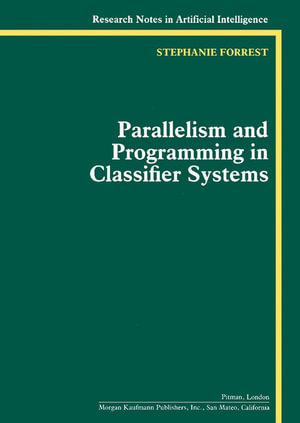
Parallelism and Programming in Classifier Systems - Stephanie Forrest

Parallelism and Programming in Classifier Systems

By: Stephanie Forrest

eText | 28 June 2014

At a Glance

eText


$83.55

or 4 interest-free payments of $20.89 with

 or 

Instant online reading in your Booktopia eTextbook Library *

Why choose an eTextbook?

Instant Access *

Purchase and read your book immediately

Read Aloud

Listen and follow along as Bookshelf reads to you

Study Tools

Built-in study tools like highlights and more

* eTextbooks are not downloadable to your eReader or an app and can be accessed via web browsers only. You must be connected to the internet and have no technical issues with your device or browser that could prevent the eTextbook from operating.
Parallelism and Programming in Classifier Systems deals with the computational properties of the underlying parallel machine, including computational completeness, programming and representation techniques, and efficiency of algorithms. In particular, efficient classifier system implementations of symbolic data structures and reasoning procedures are presented and analyzed in detail.
The book shows how classifier systems can be used to implement a set of useful operations for the classification of knowledge in semantic networks. A subset of the KL-ONE language was chosen to demonstrate these operations. Specifically, the system performs the following tasks: (1) given the KL-ONE description of a particular semantic network, the system produces a set of production rules (classifiers) that represent the network; and (2) given the description of a new term, the system determines the proper location of the new term in the existing network. These two parts of the system are described in detail. The implementation reveals certain computational properties of classifier systems, including completeness, operations that are particularly natural and efficient, and those that are quite awkward. The book shows how high-level symbolic structures can be built up from classifier systems, and it demonstrates that the parallelism of classifier systems can be exploited to implement them efficiently. This is significant since classifier systems must construct large sophisticated models and reason about them if they are to be truly ""intelligent.""
Parallel organizations are of interest to many areas of computer science, such as hardware specification, programming language design, configuration of networks of separate machines, and artificial intelligence This book concentrates on a particular type of parallel organization and a particular problem in the area of AI, but the principles that are elucidated are applicable in the wider setting of computer science.
on
Desktop
Tablet
Mobile

More in Algorithms & Data Structures

Addiction by Design : Machine Gambling in Las Vegas - Natasha Dow Schüll

eBOOK