

Get Free Shipping on orders over $79
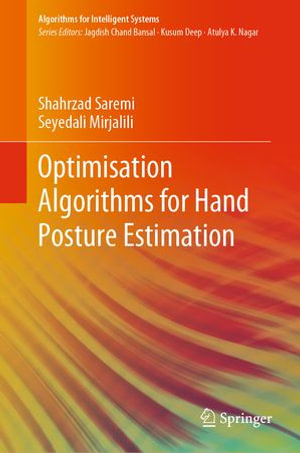
Optimisation Algorithms for Hand Posture Estimation : Intelligent Technologies and Robotics (R0) - Shahrzad Saremi

Optimisation Algorithms for Hand Posture Estimation

By: Shahrzad Saremi, Seyedali Mirjalili

eText | 26 August 2019

At a Glance

eText


$129.00

or 4 interest-free payments of $32.25 with

 or 

Instant online reading in your Booktopia eTextbook Library *

Why choose an eTextbook?

Instant Access *

Purchase and read your book immediately

Read Aloud

Listen and follow along as Bookshelf reads to you

Study Tools

Built-in study tools like highlights and more

* eTextbooks are not downloadable to your eReader or an app and can be accessed via web browsers only. You must be connected to the internet and have no technical issues with your device or browser that could prevent the eTextbook from operating.

This book reviews the literature on hand posture estimation using generative methods, identifying the current gaps, such as sensitivity to hand shapes, sensitivity to a good initial posture, difficult hand posture recovery in cases of loss in tracking, and lack of addressing multiple objectives to maximize accuracy and minimize computational cost. To fill these gaps, it proposes a new 3D hand model that combines the best features of the current 3D hand models in the literature. It also discusses the development of a hand shape optimization technique. To find the global optimum for the single-objective problem formulated, it improves and applies particle swarm optimization (PSO), one of the most highly regarded optimization algorithms and one that is used successfully in both science and industry. After formulating the problem, multi-objective particle swarm optimization (MOPSO) is employed to estimate the Pareto optimal front as the solution for this bi-objective problem. The book alsodemonstrates the effectiveness of the improved PSO in hand posture recovery in cases of tracking loss. Lastly, the book examines the formulation of hand posture estimation as a bi-objective problem for the first time.

The case studies included feature 50 hand postures extracted from five standard datasets, and were used to benchmark the proposed 3D hand model, hand shape optimization, and hand posture recovery.

on
Desktop
Tablet
Mobile

More in Artificial Intelligence

AI-Powered Search - Trey Grainger

eBOOK

Human-Agent Manifesto - Ronald Myers

eBOOK

Coming of Age : Shared Intelligence - Steven Yates

eBOOK

The Compass - Bob Pearson

eBOOK

RRP $20.89

$19.99