

Get Free Shipping on orders over $79
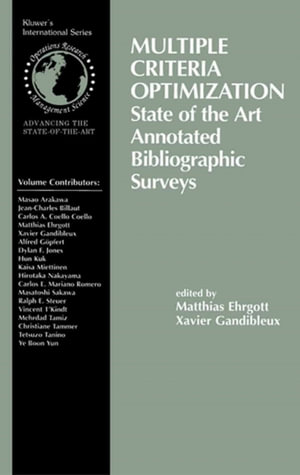
Multiple Criteria Optimization : State of the Art Annotated Bibliographic Surveys - Xavier Gandibleux

Multiple Criteria Optimization

State of the Art Annotated Bibliographic Surveys

By: Xavier Gandibleux

eText | 11 April 2006 | Edition Number 1

At a Glance

eText


$239.00

or 4 interest-free payments of $59.75 with

 or 

Instant online reading in your Booktopia eTextbook Library *

Why choose an eTextbook?

Instant Access *

Purchase and read your book immediately

Read Aloud

Listen and follow along as Bookshelf reads to you

Study Tools

Built-in study tools like highlights and more

* eTextbooks are not downloadable to your eReader or an app and can be accessed via web browsers only. You must be connected to the internet and have no technical issues with your device or browser that could prevent the eTextbook from operating.
The generalized area of multiple criteria decision making (MCDM) can be defined as the body of methods and procedures by which the concern for multiple conflicting criteria can be formally incorporated into the analytical process. MCDM consists mostly of two branches, multiple criteria optimization and multi-criteria decision analysis (MCDA). While MCDA is typically concerned with multiple criteria problems that have a small number of alternatives often in an environment of uncertainty (location of an airport, type of drug rehabilitation program), multiple criteria optimization is typically directed at problems formulated within a mathematical programming framework, but with a stack of objectives instead of just one (river basin management, engineering component design, product distribution). It is about the most modern treatment of multiple criteria optimization that this book is concerned. I look at this book as a nicely organized and well-rounded presentation of what I view as "new wave" topics in multiple criteria optimization. Looking back to the origins of MCDM, most people agree that it was not until about the early 1970s that multiple criteria optimization c- gealed as a field. At this time, and for about the following fifteen years, the focus was on theories of multiple objective linear programming that subsume conventional (single criterion) linear programming, algorithms for characterizing the efficient set, theoretical vector-maximum dev- opments, and interactive procedures.
on
Desktop
Tablet
Mobile

More in Operational Research

Logistics Handbook - James F. Robeson

eBOOK

Shaping Collaborative Ecosystems for Tomorrow - Igor Perko

eBOOK

Current Issues in Accounting - Niyazi Kurnaz

eBOOK

RRP $143.50

$129.99

Operations Management - Steven Bragg

eBOOK