

Get Free Shipping on orders over $79
Modeling Data Irregularities and Structural Complexities in Data Envelopment Analysis - Joe Zhu

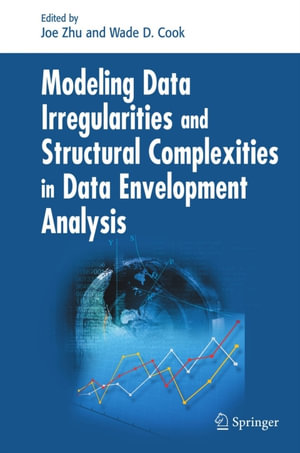
Modeling Data Irregularities and Structural Complexities in Data Envelopment Analysis

By: Joe Zhu, ?Wade D. Cook

eText | 8 June 2007 | Edition Number 1

At a Glance

eText


$159.01

or 4 interest-free payments of $39.75 with

 or 

Instant online reading in your Booktopia eTextbook Library *

Why choose an eTextbook?

Instant Access *

Purchase and read your book immediately

Read Aloud

Listen and follow along as Bookshelf reads to you

Study Tools

Built-in study tools like highlights and more

* eTextbooks are not downloadable to your eReader or an app and can be accessed via web browsers only. You must be connected to the internet and have no technical issues with your device or browser that could prevent the eTextbook from operating.
In a relatively short period of time, Data Envelopment Analysis (DEA) has grown into a powerful quantitative, analytical tool for measuring and evaluating performance. It has been successfully applied to a whole variety of problems in many different contexts worldwide. The analysis of an array of these problems has been resistant to other methodological approaches because of the multiple levels of complexity that must be considered. Several examples of multifaceted problems in which DEA analysis has been successfully used are: (1) maintenance activities of US Air Force bases in geographically dispersed locations, (2) policy force efficiencies in the United Kingdom, (3) branch bank performances in Canada, Cyprus, and other countries and (4) the efficiency of universities in performing their education and research functions in the U.S., England, and France. In addition to localized problems, DEA applications have been extended to performance evaluations of 'larger entities' such as cities, regions, and countries. These extensions have a wider scope than traditional analyses because they include "social" and "quality-of-life" dimensions which require the modeling of qualitative and quantitative data in order to analyze the layers of complexity for an evaluation of performance and to provide solution strategies. DEA is computational at its core and this book will be one of several books that we will look to publish on the computational aspects of DEA. This book by Zhu and Cook will deal with the micro aspects of handling and modeling data issues in modeling DEA problems. DEA's use has grown with its capability of dealing with complex "service industry" and the "public service domain" types of problems that require modeling both qualitative and quantitative data. This will be a handbook treatment dealing with specific data problems including the following: (1) imprecise data, (2) inaccurate data, (3) missing data, (4) qualitative data, (5) outliers, (6) undesirable outputs, (7) quality data, (8) statistical analysis, (9) software and other data aspects of modeling complex DEA problems. In addition, the book will demonstrate how to visualize DEA results when the data is more than 3-dimensional, and how to identify efficiency units quickly and accurately.
on
Desktop
Tablet
Mobile

More in Operational Research

Logistics Handbook - James F. Robeson

eBOOK

Shaping Collaborative Ecosystems for Tomorrow - Igor Perko

eBOOK

Current Issues in Accounting - Niyazi Kurnaz

eBOOK

RRP $143.50

$129.99

Operations Management - Steven Bragg

eBOOK