Get Free Shipping on orders over $79
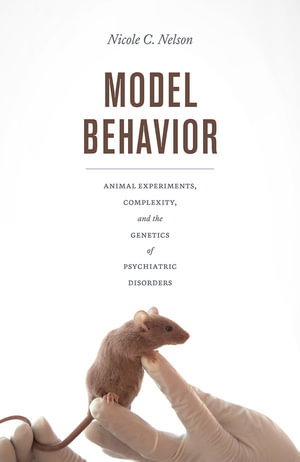
Model Behavior : Animal Experiments, Complexity, and the Genetics of Psychiatric Disorders - Nicole C. Nelson

Model Behavior

Animal Experiments, Complexity, and the Genetics of Psychiatric Disorders

By: Nicole C. Nelson

eText | 4 April 2018

At a Glance

eText


$52.77

or 4 interest-free payments of $13.19 with

 or 

Instant online reading in your Booktopia eTextbook Library *

Why choose an eTextbook?

Instant Access *

Purchase and read your book immediately

Read Aloud

Listen and follow along as Bookshelf reads to you

Study Tools

Built-in study tools like highlights and more

* eTextbooks are not downloadable to your eReader or an app and can be accessed via web browsers only. You must be connected to the internet and have no technical issues with your device or browser that could prevent the eTextbook from operating.

Mice are used as model organisms across a wide range of fields in science today—but it is far from obvious how studying a mouse in a maze can help us understand human problems like alcoholism or anxiety. How do scientists convince funders, fellow scientists, the general public, and even themselves that animal experiments are a good way of producing knowledge about the genetics of human behavior? In Model Behavior, Nicole C. Nelson takes us inside an animal behavior genetics laboratory to examine how scientists create and manage the foundational knowledge of their field.
Behavior genetics is a particularly challenging field for making a clear-cut case that mouse experiments work, because researchers believe that both the phenomena they are studying and the animal models they are using are complex. These assumptions of complexity change the nature of what laboratory work produces. Whereas historical and ethnographic studies traditionally portray the laboratory as a place where scientists control, simplify, and stabilize nature in the service of producing durable facts, the laboratory that emerges from Nelson's extensive interviews and fieldwork is a place where stable findings are always just out of reach. The ongoing work of managing precarious experimental systems means that researchers learn as much—if not more—about the impact of the environment on behavior as they do about genetics. Model Behavior offers a compelling portrait of life in a twenty-first-century laboratory, where partial, provisional answers to complex scientific questions are increasingly the norm.

on
Desktop
Tablet
Mobile

More in Zoology & Animal Sciences

The Geese of Beaver Bog - Bernd Heinrich

eBOOK

Postcards from the Zoo - Darill Clements

eBOOK