Get Free Shipping on orders over $79
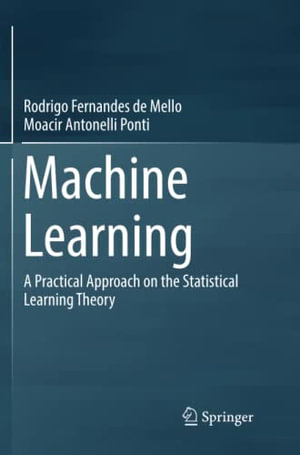
Machine Learning : A Practical Approach on the Statistical Learning Theory - RODRIGO F MELLO

Machine Learning

A Practical Approach on the Statistical Learning Theory

By: RODRIGO F MELLO, Moacir Antonelli Ponti

eText | 1 August 2018

At a Glance

eText


$99.00

or 4 interest-free payments of $24.75 with

 or 

Instant online reading in your Booktopia eTextbook Library *

Why choose an eTextbook?

Instant Access *

Purchase and read your book immediately

Read Aloud

Listen and follow along as Bookshelf reads to you

Study Tools

Built-in study tools like highlights and more

* eTextbooks are not downloadable to your eReader or an app and can be accessed via web browsers only. You must be connected to the internet and have no technical issues with your device or browser that could prevent the eTextbook from operating.

This book presents the Statistical Learning Theory in a detailed and easy to understand way, by using practical examples, algorithms and source codes. It can be used as a textbook in graduation or undergraduation courses, for self-learners, or as reference with respect to the main theoretical concepts of Machine Learning. Fundamental concepts of Linear Algebra and Optimization applied to Machine Learning are provided, as well as source codes in R, making the book as self-contained as possible.

It starts with an introduction to Machine Learning concepts and algorithms such as the Perceptron, Multilayer Perceptron and the Distance-Weighted Nearest Neighbors with examples, in order to provide the necessary foundation so the reader is able to understand the Bias-Variance Dilemma, which is the central point of the Statistical Learning Theory.

Afterwards, we introduce all assumptions and formalize the Statistical Learning Theory, allowing the practical study of different classification algorithms. Then, we proceed with concentration inequalities until arriving to the Generalization and the Large-Margin bounds, providing the main motivations for the Support Vector Machines.

From that, we introduce all necessary optimization concepts related to the implementation of Support Vector Machines. To provide a next stage of development, the book finishes with a discussion on SVM kernels as a way and motivation to study data spaces and improve classification results.

on
Desktop
Tablet
Mobile

Other Editions and Formats

Paperback

Published: 1st February 2019

More in Artificial Intelligence

AI-Powered Search - Trey Grainger

eBOOK

HBR Guide to Generative AI for Managers : HBR Guide - Elisa Farri

eBOOK

AI : The End of Human Race - Alex Wood

eBOOK