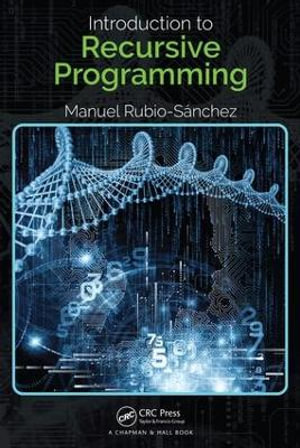
Recursion is one of the most fundamental concepts in computer science and a key programming technique that allows computations to be carried out repeatedly. Despite the importance of recursion for algorithm design, most programming books do not cover the topic in detail, despite the fact that numerous computer programming professors and researchers in the field of computer science education agree that recursion is difficult for novice students.
Introduction to Recursive Programming
provides a detailed and comprehensive introduction to recursion. This text will serve as a useful guide for anyone who wants to learn how to think and program recursively, by analyzing a wide variety of computational problems of diverse difficulty.
It contains specific chapters on the most common types of recursion (linear, tail, and multiple), as well as on algorithm design paradigms in which recursion is prevalent (divide and conquer, and backtracking). Therefore, it can be used in introductory programming courses, and in more advanced classes on algorithm design. The book also covers lower-level topics related to iteration and program execution, and includes a rich chapter on the theoretical analysis of the computational cost of recursive programs, offering readers the possibility to learn some basic mathematics along the way.
It also incorporates several elements aimed at helping students master the material. First, it contains a larger collection of simple problems in order to provide a solid foundation of the core concepts, before diving into more complex material. In addition, one of the book''s main assets is the use of a step-by-step methodology, together with specially designed diagrams, for guiding and illustrating the process of developing recursive algorithms. Furthermore, the book covers combinatorial problems and mutual recursion. These topics can broaden students'' understanding of recursion by forcing them to apply the learned concepts differently, or in a more sophisticated manner.
The code examples have been written in Python 3, but should be straightforward to understand for students with experience in other programming languages. Finally, worked out solutions to over 120 end-of-chapter exercises are available for instructors.
Industry Reviews
Recursion is a fundamental topic in computer science, but one that is frequently taught in a fragmented way as part of an introductory course and then set aside for such electives as discrete programming and difference equations. Rubio-Sanchez (Universidad Rey Juan Carlos, Spain) believes that there are better ways to approach a concept so powerfully connected to computation. His book provides a comprehensive and approachable treatment of recursive programming. The text contains mathematical proofs, as well as clear methods that students can follow to derive new results and expand their knowledge in areas the book may not cover. Many of the fundamental problems that recursion can solve are presented and discussed; more advanced problems are addressed through decomposition and analysis. The book also contains a section on algorithm analysis, which helps form the basis for more advanced material on computational complexity. This book is useful as a textbook for introductory programming courses when an instructor adopts a more fundamental approach than imperative programming, but it can also serve as a useful reference for those who wish to explore recursive programming on their own, or for algorithm designers in the industry.
--L. Benedicenti, University of New Brunswick (CHOICE)
Recursion is a fundamental topic in computer science, but one that is frequently taught in a fragmented way as part of an introductory course and then set aside for such electives as discrete programming and difference equations. Rubio-Sanchez (Universidad Rey Juan Carlos, Spain) believes that there are better ways to approach a concept so powerfully connected to computation. His book provides a comprehensive and approachable treatment of recursive programming. The text contains mathematical proofs, as well as clear methods that students can follow to derive new results and expand their knowledge in areas the book may not cover. Many of the fundamental problems that recursion can solve are presented and discussed; more advanced problems are addressed through decomposition and analysis. The book also contains a section on algorithm analysis, which helps form the basis for more advanced material on computational complexity. This book is useful as a textbook for introductory programming courses when an instructor adopts a more fundamental approach than imperative programming, but it can also serve as a useful reference for those who wish to explore recursive programming on their own, or for algorithm designers in the industry.
--L. Benedicenti, University of New Brunswick (CHOICE)