Get Free Shipping on orders over $0
Interpreting the Constitution - Kent Greenawalt
eTextbook alternate format product

Instant online reading.
Don't wait for delivery!

Go digital and save!

Interpreting the Constitution

By: Kent Greenawalt

Hardcover | 1 December 2015

At a Glance

Hardcover


RRP $182.95

$136.75

25%OFF

or 4 interest-free payments of $34.19 with

 or 

Ships in 7 to 10 business days

This third volume about legal interpretation focuses on the interpretation of a constitution, most specifically that of the United States of America. In what may be unique, it combines a generalized account of various claims and possibilities with an examination of major domains of American constitutional law. This demonstrates convincingly that the book's major themes not only can be supported by individual examples, but are undeniably in accord with the continuing practice of the United States Supreme Court over time, and cannot be dismissed as misguided.

The book's central thesis is that strategies of constitutional interpretation cannot be simple, that judges must take account of multiple factors not systematically reducible to any clear ordering. For any constitution that lasts over centuries and is hard to amend, original understanding cannot be completely determinative. To discern what that is, both how informed readers grasped a provision and what were the enactors' aims matter. Indeed, distinguishing these is usually extremely difficult, and often neither is really discernible. As time passes what modern citizens understand becomes important, diminishing the significance of original understanding. Simple versions of textualist originalism neither reflect what has taken place nor is really supportable.

The focus on specific provisions shows, among other things, the obstacles to discerning original understanding, and why the original sense of proper interpretation should itself carry importance. For applying the Bill of Rights to states, conceptions conceived when the Fourteenth Amendment was adopted should take priority over those in 1791. But practically, for courts, to interpret provisions differently for the federal and state governments would be highly unwise. The scope of various provisions, such as those regarding free speech and cruel and unusual punishment, have expanded hugely since both 1791 and 1865. And questions such as how much deference judges should accord the political branches depend greatly on what provisions and issues are involved. Even with respect to single provisions, such as the Free Speech Clause, interpretive approaches have sensibly varied, greatly depending on the more particular subjects involved. How much deference judges should accord political
actors also depends critically on the kind of issue involved.

More in Constitution & The Government & The State

The People's Guide to the Australian Constitution - Rosalind Dixon
Russia's Foreign Policy : Change and Continuity - Andrei P. Tsygankov

RRP $150.00

$134.75

10%
OFF
A Concise History Of American Law - William E. Nelson
Carceral Worlds : Legacies, Textures and Futures - Hanneke  Stuit
Practical Social Democracy - Jonas  Hinnfors

RRP $220.95

$193.75

12%
OFF
Practical Social Democracy - Magnus Feldmann

RRP $76.95

$72.75

The Australian Constitution as it is Actually Written - Graham L Paterson
Authoritarianism : Global Perspectives - William Reinert
The New Silk Roads : Present and Future of the World - Professor Peter Frankopan
Mao : The Unknown Story - Jung Chang

RRP $29.99

$24.99

17%
OFF
The Prince : The Design by Coralie Bickford-Smith - Niccolo Machiavelli

RRP $26.99

$22.99

15%
OFF
The Prince : Collins Classics - Niccolo Machiavelli

RRP $9.99

$8.75

12%
OFF
How to Defend Australia - Hugh White

RRP $36.99

$29.75

20%
OFF
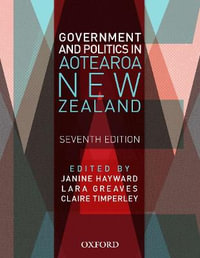
Government and Politics in Aotearoa New Zealand : 7th edition - Janine Hayward
A History of Thailand - Chris Baker

RRP $42.95

$40.75

American Government For Dummies : For Dummies - Marcus A. Stadelmann

RRP $41.95

$29.37

30%
OFF