Get Free Shipping on orders over $79
Diffusion Tensor Imaging : Introduction and Atlas - Bram Stieltjes

Diffusion Tensor Imaging

Introduction and Atlas

By: Bram Stieltjes, Romuald M. Brunner, Klaus Fritzsche, Frederik Laun

eText | 14 February 2013

At a Glance

eText


$319.00

or 4 interest-free payments of $79.75 with

 or 

Instant online reading in your Booktopia eTextbook Library *

Why choose an eTextbook?

Instant Access *

Purchase and read your book immediately

Read Aloud

Listen and follow along as Bookshelf reads to you

Study Tools

Built-in study tools like highlights and more

* eTextbooks are not downloadable to your eReader or an app and can be accessed via web browsers only. You must be connected to the internet and have no technical issues with your device or browser that could prevent the eTextbook from operating.
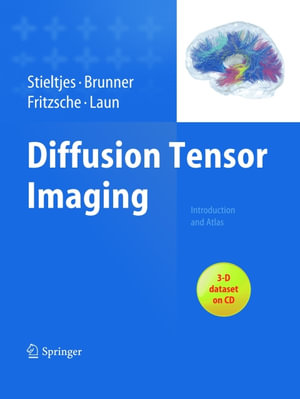
Diffusion Tensor Imaging (DTI) is a variation of diffusion-weighed imaging. Particularly in the neurosciences, this technique has gained tremendous momentum in the past decade, both from a technical point of view as well as in its applications. DTI is mainly used in neurological diagnosis and psychiatric and neurologic research, e.g. in order to locate brain tumors and depict their invasivity. DTI offers a unique in-vivo insight into the three-dimensional structure of the human central nervous system. While easy interpretation and evaluation is often hampered by the complexity of both the technique and neuroanatomy, this atlas helps you recognize every one of the important structures rapidly and unambiguously. In the introduction, this atlas provides a concise outline of the evolution of diffusion imaging and describes its potential applications. In the core part of the atlas, the neuroanatomically important structures are clearly labeled both on DTI-derived color maps and conventional MRI. Complex fiber architecture is illustrated schematically and described concisely in textboxes directly on the relevant page. In the final part of the atlas, a straightforward, step-by-step approach for the three-dimensional reconstruction of the most prominent fiber structures is given, and potential pitfalls are indicated. The atlas aims at neuroscientists, neuroanatomists, neurologists, psychiatrists, clinical psychologists, physicists, and computer scientists. For advanced users, the atlas may serve as a reference work, while students and scientists are thoroughly introduced into DTI.
on
Desktop
Tablet
Mobile

More in Neurology & Clinical Neurophysiology

The Memory Book - Janet Wiles

eBOOK

$20.99