

Get Free Shipping on orders over $79
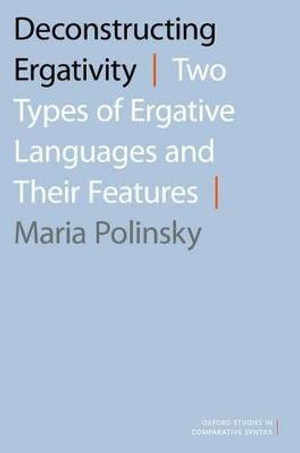
Deconstructing Ergativity : Two Types of Ergative Languages and Their Features - Maria Polinsky
eTextbook alternate format product

Instant online reading.
Don't wait for delivery!

Go digital and save!

Deconstructing Ergativity

Two Types of Ergative Languages and Their Features

By: Maria Polinsky

Paperback | 9 June 2016

At a Glance

Paperback


RRP $142.95

$103.75

27%OFF

or 4 interest-free payments of $25.94 with

 or 

Ships in 7 to 10 business days

Nominative-accusative and ergative are two common alignment types found across languages. In the former type, the subject of an intransitive verb and the subject of a transitive verb are expressed the same way, and differently from the object of a transitive. In ergative languages, the subject of an intransitive and the object of a transitive appear in the same form, the absolutive, and the transitive subject has a special, ergative, form. Ergative languages often follow very different patterns, thus evading a uniform description and analysis. A simple explanation for that has to do with the idea that ergative languages, much as their nominative-accusative counterparts, do not form a uniform class. In this book, Maria Polinsky argues that ergative languages instantiate two main types, the one where the ergative subject is a prepositional phrase (PP-ergatives) and the one with a noun-phrase ergative. Each type is internally consistent and is characterized by a set of well-defined
properties.

The book begins with an analysis of syntactic ergativity, which as Polinsky argues, is a manifestation of the PP-ergative type. Polinsky discusses diagnostic properties that define PPs in general and then goes to show that a subset of ergative expressions fit the profile of PPs. Several alternative analyses have been proposed to account for syntactic ergativity; the book presents and outlines these analyses and offers further considerations in support of the PP-ergativity approach. The book then discusses the second type, DP-ergative languages, and traces the diachronic connection between the two types.

The book includes two chapters illustrating paradigm PP-ergative and DP-ergative languages: Tongan and Tsez. The data used in these descriptions come from Polinsky's original fieldwork hence presenting new empirical facts from both languages.
Industry Reviews
"Polinsky provides a new and systematic approach to describing ergative languages that offers attractively simple categories, clearly defined and empirically testable conditions, and data from a set of relevant languages to back up the suggestions made. The dichotomy between PP-ergative and DP-ergative languages proposed is essentially theory-neutral and makes a number of interesting observations awaiting further testing. As such, this monograph will be of interest to anyone working on ergative languages, particularly on syntactical ergativity, and to typologists in general. Certain parts (esp. Chapter 8) may also be of interest to historical linguists. The analytical methods used and proposals made concerning specific languages may further be relevant for linguists working in transformational syntax or on Polynesian and Caucasian languages."--Linguist List

More in Historical & Comparative Linguistics

The Private Lives of English Words : Routledge Revivals - Louis Heller
Schott's Significa : An Unexpectedly Essential Guide to Language - Ben Schott
Bookish Words & their Surprising Stories - David Crystal

RRP $32.99

$28.75

13%
OFF
The Pocket Aussie English : Gemini Pockets - Gemini Books
A Student's Introduction to English Grammar : 2nd edition - Brett Reynolds
The Psychology of Language : From Data to Theory 4th Edition - Trevor A. Harley
The Official Guide to PTE Academic : Industrial Ecology - Pearson Education
Beginning Biblical Hebrew : A Grammar and Illustrated Reader - John A. Cook
Language and Social Justice : Global Perspectives - Dr Bernard C.  Perley
Comparing Linguistic Diachronies : The Naxos Papers (Volume III) - Dr Nikolaos  Lavidas