

Get Free Shipping on orders over $89
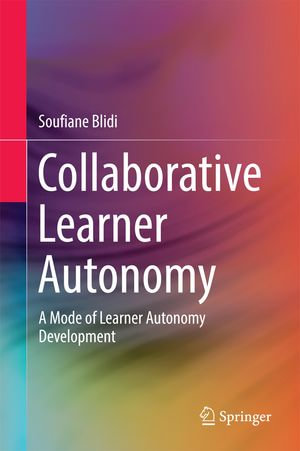
Collaborative Learner Autonomy : A Mode of Learner Autonomy Development - Soufiane Blidi

Collaborative Learner Autonomy

A Mode of Learner Autonomy Development

By: Soufiane Blidi

eText | 20 September 2016

At a Glance

eText


$169.00

or 4 interest-free payments of $42.25 with

 or 

Instant online reading in your Booktopia eTextbook Library *

Why choose an eTextbook?

Instant Access *

Purchase and read your book immediately

Read Aloud

Listen and follow along as Bookshelf reads to you

Study Tools

Built-in study tools like highlights and more

* eTextbooks are not downloadable to your eReader or an app and can be accessed via web browsers only. You must be connected to the internet and have no technical issues with your device or browser that could prevent the eTextbook from operating.

The book investigates interest groups and various learning circles, Reading Circles (RCs) learning opportunity in particular, as a mode of in-class and beyond class autonomous learning in the context of English Language Teaching (ELT) at tertiary level in Oman, and in similar contexts in the Middle East and North Africa (MENA) region. This investigation presents learners' positive perceptions of learner autonomy and their readiness to adopt related practices. Building on findings from these RCs, the book introduces collaborative learner autonomy (CLA) as a novel concept of learner autonomy for use in educational contexts in the MENA region. As a concept of gradual development of learner autonomy, the CLA represents a new dynamic learner autonomy development process consisting of individual, competitive, collaborative, and autonomous stages. The CLA advocated in the book emphasizes the constructive role of teachers and educational institutions can play with other stakeholders in developing autonomy in their learners. The book also suggests that it is a shared responsibility that students, teachers, educational establishments, families, society and the educational systems should assume in a spirit of partnership.

on
Desktop
Tablet
Mobile

More in Educational Psychology

The Words We Live By - Brian Burrell

eBOOK

Schools Without Failure - William Glasser M.D.

eBOOK

Ecstasy : Understanding the Psychology of Joy - Robert A. Johnson

eBOOK

Paideia Proposal - Mortimer J. Adler

eBOOK