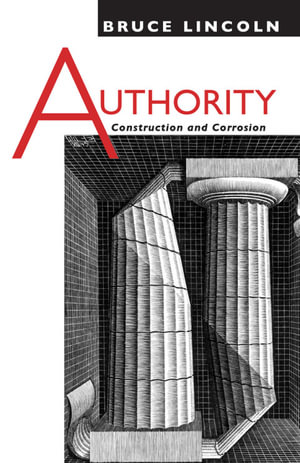
What is authority? How is it constituted? How ought one understand the subtle (and sometimes not-so-subtle) relations between authority and coercion? Between authorized and subversive speech? In this fascinating and intricate analysis, Bruce Lincoln argues that authority is not an entity but an effect. More precisely, it is an effect that depends for its power on the combination of the right speaker, the right speech, the right staging and props, the right time and place, and an audience historically and culturally conditioned to judge what is right in all these instances and to respond with trust, respect, and even reverence.
Employing a vast array of examples drawn from classical antiquity, Scandinavian law, Cold War scholarship, and American presidential politics, Lincoln offers a telling analysis of the performance of authority, and subversions of it, from ancient times to the present. Using a small set of case studies that highlight critical moments in the construction of authority, he goes on to offer a general examination of "corrosive" discourses such as gossip, rumor, and curses; the problematic situation of women, who often are barred from the authorizing sphere; the role of religion in the construction of authority; the question of whether authority in the modern and postmodern world differs from its premodern counterpart; and a critique of Hannah Arendt's claims that authority has disappeared from political life in the modern world. He does not find a diminution of authority or a fundamental change in the conditions that produce it. Rather, Lincoln finds modern authority splintered, expanded, and, in fact, multiplied as the mechanisms for its construction become more complex—and more expensive.