Get Free Shipping on orders over $79
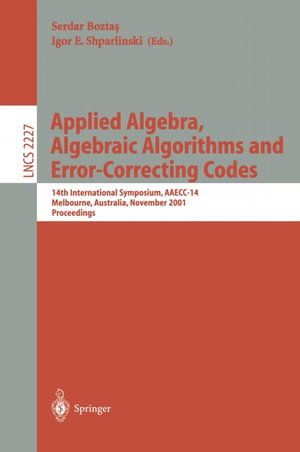
Applied Algebra, Algebraic Algorithms and Error-Correcting Codes : 14th International Symposium, AAECC-14, Melbourne, Australia, November 26-30, 2001. Proceedings - Serdar Boztas

Applied Algebra, Algebraic Algorithms and Error-Correcting Codes

14th International Symposium, AAECC-14, Melbourne, Australia, November 26-30, 2001. Proceedings

By: Serdar Boztas, Igor E. Shparlinski

eText | 30 June 2003 | Edition Number 1

At a Glance

eText


$84.99

or 4 interest-free payments of $21.25 with

 or 

Instant online reading in your Booktopia eTextbook Library *

Why choose an eTextbook?

Instant Access *

Purchase and read your book immediately

Read Aloud

Listen and follow along as Bookshelf reads to you

Study Tools

Built-in study tools like highlights and more

* eTextbooks are not downloadable to your eReader or an app and can be accessed via web browsers only. You must be connected to the internet and have no technical issues with your device or browser that could prevent the eTextbook from operating.
The AAECC Symposia Series was started in 1983 by Alain Poli (Toulouse), who, together with R. Desq, D. Lazard, and P. Camion, organized the ?rst conference. Originally the acronym AAECC meant "Applied Algebra and Error-Correcting Codes". Over the years its meaning has shifted to "Applied Algebra, Algebraic Algorithms, and Error-Correcting Codes", re?ecting the growing importance of complexity in both decoding algorithms and computational algebra. AAECC aims to encourage cross-fertilization between algebraic methods and their applications in computing and communications. The algebraic orientation is towards ?nite ?elds, complexity, polynomials, and graphs. The applications orientation is towards both theoretical and practical error-correction coding, and, since AAECC 13 (Hawaii, 1999), towards cryptography. AAECC was the ?rst symposium with papers connecting Gr¨obner bases with E-C codes. The balance between theoretical and practical is intended to shift regularly; at AAECC-14 the focus was on the theoretical side. The main subjects covered were: - Codes: iterative decoding, decoding methods, block codes, code construction. - Codes and algebra: algebraic curves, Gr¨obner bases, and AG codes. - Algebra: rings and ?elds, polynomials. - Codes and combinatorics: graphs and matrices, designs, arithmetic. - Cryptography. - Computational algebra: algebraic algorithms. - Sequences for communications.
on
Desktop
Tablet
Mobile

More in Algebra

Enriques Surfaces I - François Cossec

eTEXT

Finite Groups I - Bertram Huppert

eTEXT

$349.00

The Monodromy Group - Henryk ?o??dek

eTEXT

Interactive Linear Algebra - Conrad Plaut

eTEXT

(Generalized) Fuzzy Matrices and Relations - Herbert Toth

eBOOK

RRP $227.07

$204.99

10%
OFF