Get Free Shipping on orders over $79
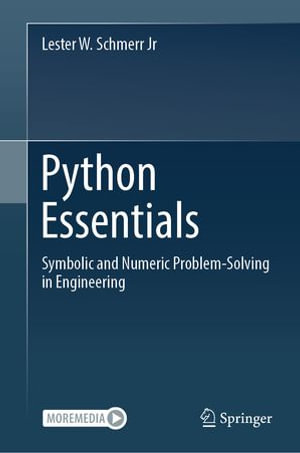
Python Essentials : Symbolic and Numeric  Problem-Solving in Engineering - Lester W. Schmerr Jr

Python Essentials

Symbolic and Numeric  Problem-Solving in Engineering

By: Lester W. Schmerr Jr

eText | 7 August 2026

At a Glance

eText


$119.00

or 4 interest-free payments of $29.75 with

 or 

Instant online reading in your Booktopia eTextbook Library *

Why choose an eTextbook?

Instant Access *

Purchase and read your book immediately

Read Aloud

Listen and follow along as Bookshelf reads to you

Study Tools

Built-in study tools like highlights and more

* eTextbooks are not downloadable to your eReader or an app and can be accessed via web browsers only. You must be connected to the internet and have no technical issues with your device or browser that could prevent the eTextbook from operating.

This text describes the essentials of the Python programming language for symbolic and numeric engineering problems, emphasizing an interactive approach. It incorporates the Spyder IDE in conjunction with the four Python packages (NumPy, SciPy, SymPy, and MatplotLib) most frequently used in engineering and the sciences. The book is divided into four parts. The first part, chapter 1, outlines the environment for using Python in an interactive mode and provides descriptions of the many functions and operations available in that environment for numerical and symbolic problem-solving and for basic 2-D plotting of results. For users with no or little experience with Python the chapter can serve as a tutorial while for users with some Python experience the chapter can serve as a reference guide. The second part of the book, contained in chapters 2 and 3, discusses vectors and arrays (matrices) from both a mathematical perspective as well as from a physical perspective. Engineering examples are provided in the chapters and the exercises. Chapters 3, 4, 5 and 8 are the third part of the book, covering the solution of 1) linear simultaneous algebraic equations, 2) nonlinear algebraic equations, 3) ordinary differential equations, and 4) partial differential equations, respectively. These topics again are covered from both a mathematical and physical standpoint with solutions obtained in engineering examples and exercises. Python animations are also introduced as part of the solutions found for ordinary differential equations. Finally, the fourth part of the book, chapter 7, covers the use of 2-D and 3-D plotting as well as symbolic plotting in detail, expanding significantly on the short introduction given in chapter 1.

on
Desktop
Tablet
Mobile

More in Computer Science

Amazon.com : Get Big Fast - Robert Spector

eBOOK

Writing Game Histories : Writing History - Esther Wright

eBOOK