



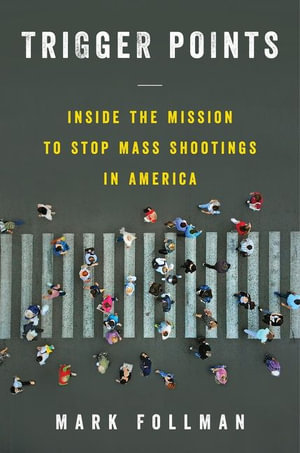
Trigger Points
Inside the Mission to Stop Mass Shootings in America
By: Mark Follman
Hardcover | 16 February 2023
At a Glance
Hardcover
RRP $49.99
$48.99
Ships in 5 to 10 business days
ISBN: 9780062973535
ISBN-10: 0062973533
Published: 16th February 2023
Format: Hardcover
Language: English
Number of Pages: 304
Audience: General Adult
Publisher: HarperCollins Publishers
Country of Publication: US
Dimensions (cm): 23.6 x 16.0 x 2.6
Weight (kg): 0.46
Shipping
| Standard Shipping | Express Shipping | |
|---|---|---|
| Metro postcodes: | $9.99 | $14.95 |
| Regional postcodes: | $9.99 | $14.95 |
| Rural postcodes: | $9.99 | $14.95 |
Orders over $49.00 qualify for free shipping.
How to return your order
At Booktopia, we offer hassle-free returns in accordance with our returns policy. If you wish to return an item, please get in touch with Booktopia Customer Care.
Additional postage charges may be applicable.
Defective items
If there is a problem with any of the items received for your order then the Booktopia Customer Care team is ready to assist you.
For more info please visit our Help Centre.
You Can Find This Book In

RRP $36.99
$29.99
OFF



RRP $36.99
$29.75
OFF

RRP $44.95
$36.99
OFF

RRP $39.93
$35.75
OFF

RRP $26.99
$20.75
OFF

RRP $32.99
$3.95
OFF


RRP $16.99
$3.95
OFF

RRP $24.99
$21.75
OFF

RRP $36.99
$29.75
OFF


RRP $54.99
$53.75


RRP $29.99
$15.00
OFF

RRP $26.99
$22.99
OFF

RRP $30.90
$18.75
OFF

RRP $130.95
$87.99
OFF

RRP $26.99
$22.99
OFF

RRP $24.99
$21.75
OFF
This product is categorised by
- Non-FictionSociety & CultureSocial Issues & ProcessesViolence in Society
- Non-FictionPsychologyCriminal or Forensic Psychology
- Non-FictionBiographies & True Stories True StoriesTrue Crime
- Non-FictionSociety & CultureCultural StudiesPopular Culture
- Non-FictionSocial Services & WelfareSocial Welfare & Social ServicesSocial Work
- Non-FictionSociology & Anthropology
- Non-FictionSocial Services & WelfareCrime & Criminology
- Non-FictionPsychologySocial Psychology