Get Free Shipping on orders over $79
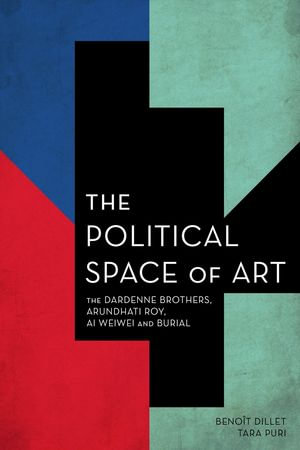
The Political Space of Art : The Dardenne Brothers, Arundhati Roy, Ai Weiwei and Burial - Benoît Dillet

The Political Space of Art

The Dardenne Brothers, Arundhati Roy, Ai Weiwei and Burial

By: Benoît Dillet, Tara Puri

eText | 18 May 2016 | Edition Number 1

At a Glance

eText


$72.00

or 4 interest-free payments of $18.00 with

 or 

Instant online reading in your Booktopia eTextbook Library *

Why choose an eTextbook?

Instant Access *

Purchase and read your book immediately

Read Aloud

Listen and follow along as Bookshelf reads to you

Study Tools

Built-in study tools like highlights and more

* eTextbooks are not downloadable to your eReader or an app and can be accessed via web browsers only. You must be connected to the internet and have no technical issues with your device or browser that could prevent the eTextbook from operating.
This book studies the tension between arts and politics in four contemporary artists from different countries, working with different media. The film directors Luc and Jean-Pierre Dardenne film parts of their natal city to refer to specific political problems in interpersonal relations. The novelist Arundhati Roy uses her poetic language to make room for people’s desires; her fiction is utterly political and her political essays make place for the role of narratives and poetic language. Ai Weiwei uses references to Chinese history to give consistency to its ‘economic miracle’. Finally, Burial’s electronic music is firmly rooted in a living, breathing London; built to create a sound that is entirely new, and yet hauntingly familiar.

These artists create in their own way a space for politics in their works and their oeuvre but their singularity comes together as a desire to reconstruct the political space within art from its ruins. These ruins were brought by the disenchantment of 1970s: the end of art, postmodernism, and the rise of design, marketing and communication. Each artwork bears the mark of the resistance against the depoliticisation of society and the arts, at once rejecting cynicism and idealism, referring to themes and political concepts that are larger than their own domain. This book focuses on these productive tensions.
Industry Reviews
Overall, this book offers a stimulating examination of the relationship between art and politics through the theoretical lens of the philosophy of art in an innovative way. The authors provide a rich set of references to different authors such as Blanchot, Deleuze, Stiegler, among others. […] [T]he value of this book is not limited to its selection of artists, but also to its focus on the political space of art and materiality. This gets rid of the traditional distinction between art, politics and the world, bringing forth a more powerful critique of our time by moving beyond the analysis of meaning or artistic merit into how art works. Although the analysis of the materiality of art fits remarkably well with the artworks examined, it might also be useful for the study of other artists, not as a method, but as a reminder of the physical space of art and its connections to the world.
on
Desktop
Tablet
Mobile

Other Editions and Formats

Hardcover

Published: 19th May 2016

More in General Issues in Art

Complete Printmaker - John Ross

eBOOK

Corbin Bleu : Up Close - Dee Scott

eBOOK

Illustrators 54 - Society of Illustrators

eBOOK

$11.99

Typography 33 - Type Directors Club

eBOOK

RRP $17.99

$14.99

17%
OFF