Get Free Shipping on orders over $49
Texts in Computer Science : Texts in Computer Science - Peter Revesz

Texts in Computer Science

By: Peter Revesz

Hardcover | 8 January 2002

At a Glance

Hardcover


$84.99

or 4 interest-free payments of $21.25 with

 or 

Ships in 5 to 7 business days

Constraint databases provide extra expressive power over relational databases in a largely hidden way at the data-storage or physical level. Constraints, such as linear or polynomial equations, are used to represent large sets in a compact manner. They keep the view of the database for a user or application programmer almost as simple as in relational databases. "Introduction to Constraint Databases" comprehensively covers both constraint-database theory and several sample systems. The book reveals how constraint databases bring together techniques from a variety of fields, such as logic and model theory, algebraic and computational geometry, and symbolic computation, to the design and analysis of data models and query languages. Constraint databases are shown to be powerful and simple tools for data modeling and querying in application areasAsuch as environmental modeling, bioinformatics, and computer vision--that are not suitable for relational databases. Specific applications are examined in geographic information systems, spatiotemporal data management, linear programming, genome databases, model checking of automata, and other areas. Topics and features: *Offers a database perspective and a focus on simplicity at the user level *Utilizes simple tools for determining whether queries are safe or not *Incorporates scientist-supplied descriptions of applications *Explains constraint databases from a developer's viewpoint *Provides extensive exercise sets, and sample software systems, that facilitate rapid learning of the topic within a real-world software context This volume presents a comprehensive introduction to the theory and applications of constraint database systems, which provide new methods for the design of data models and query languages. It is an essential resource for advanced students, practitioners, and professionals in computer science, database systems, and information systems.
Industry Reviews

From the reviews:

"Constraints, such as linear or polynomial equalities, are used to finitely represent possibly infinite sets of points. They provide an elegant way to combine classical relational data with, for instance, spatial or temporal data?.This book?will certainly play an important role in spreading the ideas behind constraint databases among a wider audience, especially among students?it offers a strong background in constraint-database theory and comprehensively addresses developer's issues." --SIGMOD Records

"The textbook provides comprehensive coverage of constraint databases. The primary audience ... is for advanced undergraduate and beginning graduate students, but it is also very good reading for all who are interested in database problems. For students it is mainly the extensive set of exercises at the end of each chapter that is useful. ... database experts will also find the rich bibliographic notes after each chapter to be valuable references ... . A special strength of the book is that it allows course design." (Ing. Jaroslav Vesely, Neural Network World, Vol. 14 (6), 2004)

"An interesting book from many views. ... The book summarises interesting information about constraint databases. It is useful for practitioners, researchers and students working in the fields of databases, GIS systems, computer vision systems and any other large information systems with requirements of complex queries, especially with respect to optimization tasks. The book presents an unusual view of database systems and suggests relations to many different areas so that it can be inspirable to anybody using a computer not only as a typewriter." (Tomas Brandejsky, Neural Network World, Vol. 14 (2), 2004)

"This book is the first textbook on constraint databases. ... extensive exercise sets are provided and sample software systems of real-world applications are available on the author's web page. ... The chapters contain valuablebibliographical references for further reading. ... This book takes a unique place and will certainly play an important role in spreading the ideas behind constraint databases ... . There is certainly a need for a book like this. ... I would certainly recommend this book for teaching constraint databases ... ." (Bart Kuipers, Theory and Practice of Logic Programming, Vol. 3, November, 2003)

More in Computer Programming & Software Development

Design Patterns : Elements of Reusable Object-Oriented Software - Erich Gamma
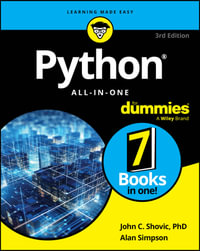
Python All-in-One For Dummies : 3rd Edition - John C. Shovic

RRP $74.95

$49.99

33%
OFF
Web Engineering : Theory and Practice - Jeremiah Downey
The Essence of Software Engineering - Cersei Page
Introduction to Programming Languages - Gordon Hurley
Swift : The Practical Guide - Kerem Koseoglu
Learning Go : An Idiomatic Approach to Real-World Go Programming - Jon Bodner
Building Microservices : Designing Fine-Grained Systems 2nd Edition - Sam Newman
Theory of Fun for Game Design - Raph Koster

RRP $85.75

$68.60

20%
OFF