Get Free Shipping on orders over $0
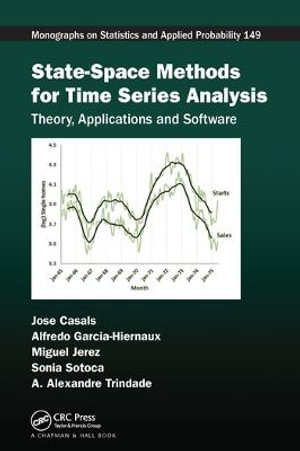
State-Space Methods for Time Series Analysis : Theory, Applications and Software - Jose Casals

State-Space Methods for Time Series Analysis

Theory, Applications and Software

By: Jose Casals, Alfredo Garcia-Hiernaux, Miguel Jerez, Sonia Sotoca, A. Alexandre Trindade

eText | 3 September 2018 | Edition Number 1

At a Glance

eText


$115.50

or 4 interest-free payments of $28.88 with

 or 

Instant online reading in your Booktopia eTextbook Library *

Why choose an eTextbook?

Instant Access *

Purchase and read your book immediately

Read Aloud

Listen and follow along as Bookshelf reads to you

Study Tools

Built-in study tools like highlights and more

* eTextbooks are not downloadable to your eReader or an app and can be accessed via web browsers only. You must be connected to the internet and have no technical issues with your device or browser that could prevent the eTextbook from operating.

The state-space approach provides a formal framework where any result or procedure developed for a basic model can be seamlessly applied to a standard formulation written in state-space form. Moreover, it can accommodate with a reasonable effort nonstandard situations, such as observation errors, aggregation constraints, or missing in-sample values.

Exploring the advantages of this approach, State-Space Methods for Time Series Analysis: Theory, Applications and Software presents many computational procedures that can be applied to a previously specified linear model in state-space form.

After discussing the formulation of the state-space model, the book illustrates the flexibility of the state-space representation and covers the main state estimation algorithms: filtering and smoothing. It then shows how to compute the Gaussian likelihood for unknown coefficients in the state-space matrices of a given model before introducing subspace methods and their application. It also discusses signal extraction, describes two algorithms to obtain the VARMAX matrices corresponding to any linear state-space model, and addresses several issues relating to the aggregation and disaggregation of time series. The book concludes with a cross-sectional extension to the classical state-space formulation in order to accommodate longitudinal or panel data. Missing data is a common occurrence here, and the book explains imputation procedures necessary to treat missingness in both exogenous and endogenous variables.

Web Resource
The authors' E4 MATLAB® toolbox offers all the computational procedures, administrative and analytical functions, and related materials for time series analysis. This flexible, powerful, and free software tool enables readers to replicate the practical examples in the text and apply the procedures to their own work.

on
Desktop
Tablet
Mobile

Other Editions and Formats

Paperback

Published: 30th June 2020

More in Applied Mathematics