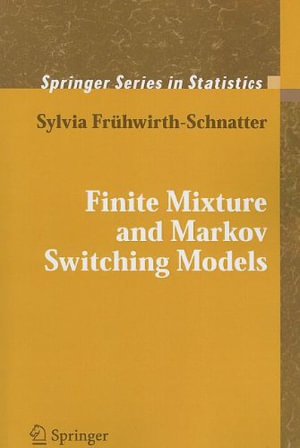
| Finite Mixture Modeling | p. 1 |
| Introduction | p. 1 |
| Finite Mixture Distributions | p. 3 |
| Basic Definitions | p. 3 |
| Some Descriptive Features of Finite Mixture Distributions | p. 5 |
| Diagnosing Similarity of Mixture Components | p. 9 |
| Moments of a Finite Mixture Distribution | p. 10 |
| Statistical Modeling Based on Finite Mixture Distributions | p. 11 |
| Identifiability of a Finite Mixture Distribution | p. 14 |
| Nonidentifiability Due to Invariance to Relabeling the Components | p. 15 |
| Nonidentifiability Due to Potential Overfitting | p. 17 |
| Formal Identifiability Constraints | p. 19 |
| Generic Identifiability | p. 21 |
| Statistical Inference for a Finite Mixture Model with Known Number of Components | p. 25 |
| Introduction | p. 25 |
| Classification for Known Component Parameters | p. 26 |
| Bayes' Rule for Classifying a Single Observation | p. 26 |
| The Bayes' Classifier for a Whole Data Set | p. 27 |
| Parameter Estimation for Known Allocation | p. 29 |
| The Complete-Data Likelihood Function | p. 29 |
| Complete-Data Maximum Likelihood Estimation | p. 30 |
| Complete-Data Bayesian Estimation of the Component Parameters | p. 31 |
| Complete-Data Bayesian Estimation of the Weights | p. 35 |
| Parameter Estimation When the Allocations Are Unknown | p. 41 |
| Method of Moments | p. 42 |
| The Mixture Likelihood Function | p. 43 |
| A Helicopter Tour of the Mixture Likelihood Surface for Two Examples | p. 44 |
| Maximum Likelihood Estimation | p. 49 |
| Bayesian Parameter Estimation | p. 53 |
| Distance-Based Methods | p. 54 |
| Comparing Various Estimation Methods | p. 54 |
| Practical Bayesian Inference for a Finite Mixture Model with Known Number of Components | p. 57 |
| Introduction | p. 57 |
| Choosing the Prior for the Parameters of a Mixture Model | p. 58 |
| Objective and Subjective Priors | p. 58 |
| Improper Priors May Cause Improper Mixture Posteriors | p. 59 |
| Conditionally Conjugate Priors | p. 60 |
| Hierarchical Priors and Partially Proper Priors | p. 61 |
| Other Priors | p. 62 |
| Invariant Prior Distributions | p. 62 |
| Some Properties of the Mixture Posterior Density | p. 63 |
| Invariance of the Posterior Distribution | p. 63 |
| Invariance of Seemingly Component-Specific Functionals | p. 64 |
| The Marginal Posterior Distribution of the Allocations | p. 65 |
| Invariance of the Posterior Distribution of the Allocations | p. 67 |
| Classification Without Parameter Estimation | p. 68 |
| Single-Move Gibbs Sampling | p. 69 |
| The Metropolis-Hastings Algorithm | p. 72 |
| Parameter Estimation Through Data Augmentation and MCMC | p. 73 |
| Treating Mixture Models as a Missing Data Problem | p. 73 |
| Data Augmentation and MCMC for a Mixture of Poisson Distributions | p. 74 |
| Data Augmentation and MCMC for General Mixtures | p. 76 |
| MCMC Sampling Under Improper Priors | p. 78 |
| Label Switching | p. 78 |
| Permutation MCMC Sampling | p. 81 |
| Other Monte Carlo Methods Useful for Mixture Models | p. 83 |
| A Metropolis-Hastings Algorithm for the Parameters | p. 83 |
| Importance Sampling for the Allocations | p. 84 |
| Perfect Sampling | p. 85 |
| Bayesian Inference for Finite Mixture Models Using Posterior Draws | p. 85 |
| Sampling Representations of the Mixture Posterior Density | p. 85 |
| Using Posterior Draws for Bayesian Inference | p. 87 |
| Predictive Density Estimation | p. 89 |
| Individual Parameter Inference | p. 91 |
| Inference on the Hyperparameter of a Hierarchical Prior | p. 92 |
| Inference on Component Parameters | p. 92 |
| Model Identification | p. 94 |
| Statistical Inference for Finite Mixture Models Under Model Specification Uncertainty | p. 99 |
| Introduction | p. 99 |
| Parameter Estimation Under Model Specification Uncertainty | p. 100 |
| Maximum Likelihood Estimation Under Model Specification Uncertainty | p. 100 |
| Practical Bayesian Parameter Estimation for Overfitting Finite Mixture Models | p. 103 |
| Potential Overfitting | p. 105 |
| Informal Methods for Identifying the Number of Components | p. 107 |
| Mode Hunting in the Mixture Posterior | p. 108 |
| Mode Hunting in the Sample Histogram | p. 109 |
| Diagnosing Mixtures Through the Method of Moments | p. 110 |
| Diagnosing Mixtures Through Predictive Methods | p. 112 |
| Further Approaches | p. 114 |
| Likelihood-Based Methods | p. 114 |
| The Likelihood Ratio Statistic | p. 114 |
| AIC, BIC, and the Schwarz Criterion | p. 116 |
| Further Approaches | p. 117 |
| Bayesian Inference Under Model Uncertainty | p. 117 |
| Trans-Dimensional Bayesian Inference | p. 117 |
| Marginal Likelihoods | p. 118 |
| Bayes Factors for Model Comparison | p. 119 |
| Formal Bayesian Model Selection | p. 121 |
| Choosing Priors for Model Selection | p. 122 |
| Further Approaches | p. 123 |
| Computational Tools for Bayesian Inference for Finite Mixtures Models Under Model Specification Uncertainty | p. 125 |
| Introduction | p. 125 |
| Trans-Dimensional Markov Chain Monte Carlo Methods | p. 125 |
| Product-Space MCMC | p. 126 |
| Reversible Jump MCMC | p. 129 |
| Birth and Death MCMC Methods | p. 137 |
| Marginal Likelihoods for Finite Mixture Models | p. 139 |
| Defining the Marginal Likelihood | p. 139 |
| Choosing Priors for Selecting the Number of Components | p. 141 |
| Computation of the Marginal Likelihood for Mixture Models | p. 143 |
| Simulation-Based Approximations of the Marginal Likelihood | p. 143 |
| Some Background on Monte Carlo Integration | p. 143 |
| Sampling-Based Approximations for Mixture Models | p. 144 |
| Importance Sampling | p. 146 |
| Reciprocal Importance Sampling | p. 147 |
| Harmonic Mean Estimator | p. 148 |
| Bridge Sampling Technique | p. 150 |
| Comparison of Different Simulation-Based Estimators | p. 154 |
| Dealing with Hierarchical Priors | p. 159 |
| Approximations to the Marginal Likelihood Based on Density Ratios | p. 159 |
| The Posterior Density Ratio | p. 159 |
| Chib's Estimator | p. 160 |
| Laplace Approximation | p. 164 |
| Reversible Jump MCMC Versus Marginal Likelihoods? | p. 165 |
| Finite Mixture Models with Normal Components | p. 169 |
| Finite Mixtures of Normal Distributions | p. 169 |
| Model Formulation | p. 169 |
| Parameter Estimation for Mixtures of Normals | p. 171 |
| The Kiefer-Wolfowitz Example | p. 174 |
| Applications of Mixture of Normal Distributions | p. 176 |
| Bayesian Estimation of Univariate Mixtures of Normals | p. 177 |
| Bayesian Inference When the Allocations Are Known | p. 177 |
| Standard Prior Distributions | p. 179 |
| The Influence of the Prior on the Variance Ratio | p. 179 |
| Bayesian Estimation Using MCMC | p. 180 |
| MCMC Estimation Under Standard Improper Priors | p. 182 |
| Introducing Prior Dependence Among the Components | p. 185 |
| Further Sampling-Based Approaches | p. 187 |
| Application to the Fishery Data | p. 188 |
| Bayesian Estimation of Multivariate Mixtures of Normals | p. 190 |
| Bayesian Inference When the Allocations Are Known | p. 190 |
| Prior Distributions | p. 192 |
| Bayesian Parameter Estimation Using MCMC | p. 193 |
| Application to Fisher's Iris Data | p. 195 |
| Further Issues | p. 195 |
| Parsimonious Finite Normal Mixtures | p. 195 |
| Model Selection Problems for Mixtures of Normals | p. 199 |
| Data Analysis Based on Finite Mixtures | p. 203 |
| Model-Based Clustering | p. 203 |
| Some Background on Cluster Analysis | p. 203 |
| Model-Based Clustering Using Finite Mixture Models | p. 204 |
| The Classification Likelihood and the Bayesian MAP Approach | p. 207 |
| Choosing Clustering Criteria and the Number of Components | p. 210 |
| Model Choice for the Fishery Data | p. 216 |
| Model Choice for Fisher's Iris Data | p. 218 |
| Bayesian Clustering Based on Loss Functions | p. 220 |
| Clustering for Fisher's Iris Data | p. 224 |
| Outlier Modeling | p. 224 |
| Outlier Modeling Using Finite Mixtures | p. 224 |
| Bayesian Inference for Outlier Models Based on Finite Mixtures | p. 225 |
| Outlier Modeling of Darwin's Data | p. 226 |
| Clustering Under Outliers and Noise | p. 227 |
| Robust Finite Mixtures Based on the Student-t Distribution | p. 230 |
| Parameter Estimation | p. 230 |
| Dealing with Unknown Number of Components | p. 233 |
| Further Issues | p. 233 |
| Clustering High-Dimensional Data | p. 233 |
| Discriminant Analysis | p. 235 |
| Combining Classified and Unclassified Observations | p. 236 |
| Density Estimation Using Finite Mixtures | p. 237 |
| Finite Mixtures as an Auxiliary Computational Tool in Bayesian Analysis | p. 238 |
| Finite Mixtures of Regression Models | p. 241 |
| Introduction | p. 241 |
| Finite Mixture of Multiple Regression Models | p. 242 |
| Model Definition | p. 242 |
| Identifiability | p. 243 |
| Statistical Modeling Based on Finite Mixture of Regression Models | p. 246 |
| Outliers in a Regression Model | p. 249 |
| Statistical Inference for Finite Mixtures of Multiple Regression Models | p. 249 |
| Maximum Likelihood Estimation | p. 249 |
| Bayesian Inference When the Allocations Are Known | p. 250 |
| Choosing Prior Distributions | p. 252 |
| Bayesian Inference When the Allocations Are Unknown | p. 253 |
| Bayesian Inference Using Posterior Draws | p. 254 |
| Dealing with Model Specification Uncertainty | p. 255 |
| Mixed-Effects Finite Mixtures of Regression Models | p. 256 |
| Model Definition | p. 256 |
| Choosing Priors for Bayesian Estimation | p. 256 |
| Bayesian Parameter Estimation When the Allocations Are Known | p. 257 |
| Bayesian Parameter Estimation When the Allocations Are Unknown | p. 258 |
| Finite Mixture Models for Repeated Measurements | p. 259 |
| Pooling Information Across Similar Units | p. 260 |
| Finite Mixtures of Random-Effects Models | p. 260 |
| Choosing the Prior for Bayesian Estimation | p. 265 |
| Bayesian Parameter Estimation When the Allocations Are Known | p. 265 |
| Practical Bayesian Estimation Using MCMC | p. 267 |
| Dealing with Model Specification Uncertainty | p. 269 |
| Application to the Marketing Data | p. 270 |
| Further Issues | p. 273 |
| Regression Modeling Based on Multivariate Mixtures of Normals | p. 273 |
| Modeling the Weight Distribution | p. 274 |
| Mixtures-of-Experts Models | p. 274 |
| Finite Mixture Models with Nonnormal Components | p. 277 |
| Finite Mixtures of Exponential Distributions | p. 277 |
| Model Formulation and Parameter Estimation | p. 277 |
| Bayesian Inference | p. 278 |
| Finite Mixtures of Poisson Distributions | p. 279 |
| Model Formulation and Estimation | p. 279 |
| Capturing Overdispersion in Count Data | p. 280 |
| Modeling Excess Zeros | p. 282 |
| Application to the Eye Tracking Data | p. 283 |
| Finite Mixture Models for Binary and Categorical Data | p. 286 |
| Finite Mixtures of Binomial Distributions | p. 286 |
| Finite Mixtures of Multinomial Distributions | p. 288 |
| Finite Mixtures of Generalized Linear Models | p. 289 |
| Finite Mixture Regression Models for Count Data | p. 290 |
| Finite Mixtures of Logit and Probit Regression Models | p. 292 |
| Parameter Estimation for Finite Mixtures of GLMs | p. 293 |
| Model Selection for Finite Mixtures of GLMs | p. 294 |
| Finite Mixture Models for Multivariate Binary and Categorical Data | p. 294 |
| The Basic Latent Class Model | p. 295 |
| Identification and Parameter Estimation | p. 296 |
| Extensions of the Basic Latent Class Model | p. 297 |
| Further Issues | p. 298 |
| Finite Mixture Modeling of Mixed-Mode Data | p. 298 |
| Finite Mixtures of GLMs with Random Effects | p. 299 |
| Finite Markov Mixture Modeling | p. 301 |
| Introduction | p. 301 |
| Finite Markov Mixture Distributions | p. 301 |
| Basic Definitions | p. 302 |
| Irreducible Aperiodic Markov Chains | p. 304 |
| Moments of a Markov Mixture Distribution | p. 308 |
| The Autocorrelation Function of a Process Generated by a Markov Mixture Distribution | p. 310 |
| The Autocorrelation Function of the Squared Process | p. 311 |
| The Standard Finite Mixture Distribution as a Limiting Case | p. 312 |
| Identifiability of a Finite Markov Mixture Distribution | p. 313 |
| Statistical Modeling Based on Finite Markov Mixture Distributions | p. 314 |
| The Basic Markov Switching Model | p. 314 |
| The Markov Switching Regression Model | p. 315 |
| Nonergodic Markov Chains | p. 316 |
| Relaxing the Assumptions of the Basic Markov Switching Model | p. 316 |
| Statistical Inference for Markov Switching Models | p. 319 |
| Introduction | p. 319 |
| State Estimation for Known Parameters | p. 319 |
| Statistical Inference About the States | p. 320 |
| Filtered State Probabilities | p. 320 |
| Filtering for Special Cases | p. 323 |
| Smoothing the States | p. 324 |
| Filtering and Smoothing for More General Models | p. 326 |
| Parameter Estimation for Known States | p. 327 |
| The Complete-Data Likelihood Function | p. 327 |
| Complete-Data Bayesian Parameter Estimation | p. 329 |
| Complete-Data Bayesian Estimation of the Transition Matrix | p. 329 |
| Parameter Estimation When the States are Unknown | p. 330 |
| The Markov Mixture Likelihood Function | p. 330 |
| Maximum Likelihood Estimation | p. 333 |
| Bayesian Estimation | p. 334 |
| Alternative Estimation Methods | p. 334 |
| Bayesian Parameter Estimation with Known Number of States | p. 335 |
| Choosing the Prior for the Parameters of a Markov Mixture Model | p. 335 |
| Some Properties of the Posterior Distribution of a Markov Switching Model | p. 336 |
| Parameter Estimation Through Data Augmentation and MCMC | p. 337 |
| Permutation MCMC Sampling | p. 340 |
| Sampling the Unknown Transition Matrix | p. 340 |
| Sampling Posterior Paths of the Hidden Markov Chain | p. 342 |
| Other Sampling-Based Approaches | p. 345 |
| Bayesian Inference Using Posterior Draws | p. 345 |
| Statistical Inference Under Model Specification Uncertainty | p. 346 |
| Diagnosing Markov Switching Models | p. 346 |
| Likelihood-Based Methods | p. 346 |
| Marginal Likelihoods for Markov Switching Models | p. 347 |
| Model Space MCMC | p. 348 |
| Further Issues | p. 348 |
| Modeling Overdispersion and Autocorrelation in Time Series of Count Data | p. 348 |
| Motivating Example | p. 348 |
| Capturing Overdispersion and Autocorrelation Using Poisson Markov Mixture Models | p. 349 |
| Application to the Lamb Data | p. 351 |
| Nonlinear Time Series Analysis Based on Markov Switching Models | p. 357 |
| Introduction | p. 357 |
| The Markov Switching Autoregressive Model | p. 358 |
| Motivating Example | p. 358 |
| Model Definition | p. 360 |
| Features of the MSAR Model | p. 362 |
| Markov Switching Models for Nonstationary Time Series | p. 363 |
| Parameter Estimation and Model Selection | p. 365 |
| Application to Business Cycle Analysis of the U.S. GDP Data | p. 365 |
| Markov Switching Dynamic Regression Models | p. 371 |
| Model Definition | p. 371 |
| Bayesian Estimation | p. 371 |
| Prediction of Time Series Based on Markov Switching Models | p. 372 |
| Flexible Predictive Distributions | p. 372 |
| Forecasting of Markov Switching Models via Sampling-Based Methods | p. 374 |
| Markov Switching Conditional Heteroscedasticity | p. 375 |
| Motivating Example | p. 375 |
| Capturing Features of Financial Time Series Through Markov Switching Models | p. 377 |
| Switching ARCH Models | p. 378 |
| Statistical Inference for Switching ARCH Models | p. 380 |
| Switching GARCH Models | p. 383 |
| Some Extensions | p. 384 |
| Time-Varying Transition Matrices | p. 384 |
| Markov Switching Models for Longitudinal and Panel Data | p. 385 |
| Markov Switching Models for Multivariate Time Series | p. 386 |
| Switching State Space Models | p. 389 |
| State Space Modeling | p. 389 |
| The Local Level Model with and Without Switching | p. 389 |
| The Linear Gaussian State Space Form | p. 391 |
| Multiprocess Models | p. 393 |
| Switching Linear Gaussian State Space Models | p. 393 |
| The General State Space Form | p. 394 |
| Nonlinear Time Series Analysis Based on Switching State Space Models | p. 396 |
| ARMA Models with and Without Switching | p. 396 |
| Unobserved Component Time Series Models | p. 397 |
| Capturing Sudden Changes in Time Series | p. 398 |
| Switching Dynamic Factor Models | p. 400 |
| Switching State Space Models as a Semi-Parametric Smoothing Device | p. 401 |
| Filtering for Switching Linear Gaussian State Space Models | p. 401 |
| The Filtering Problem | p. 402 |
| Bayesian Inference for a General Linear Regression Model | p. 402 |
| Filtering for the Linear Gaussian State Space Model | p. 404 |
| Filtering for Multiprocess Models | p. 406 |
| Approximate Filtering for Switching Linear Gaussian State Space Models | p. 406 |
| Parameter Estimation for Switching State Space Models | p. 410 |
| The Likelihood Function of a State Space Model | p. 411 |
| Maximum Likelihood Estimation | p. 412 |
| Bayesian Inference | p. 412 |
| Practical Bayesian Estimation Using MCMC | p. 415 |
| Various Data Augmentation Schemes | p. 416 |
| Sampling the Continuous State Process from the Smoother Density | p. 417 |
| Sampling the Discrete States for a Switching State Space Model | p. 420 |
| Further Issues | p. 421 |
| Model Specification Uncertainty in Switching State Space Modeling | p. 421 |
| Auxiliary Mixture Sampling for Nonlinear and Nonnormal State Space Models | p. 422 |
| Illustrative Application to Modeling Exchange Rate Data | p. 423 |
| Appendix | p. 431 |
| Summary of Probability Distributions | p. 431 |
| The Beta Distribution | p. 431 |
| The Binomial Distribution | p. 432 |
| The Dirichlet Distribution | p. 432 |
| The Exponential Distribution | p. 433 |
| The F-Distribution | p. 433 |
| The Gamma Distribution | p. 434 |
| The Geometric Distribution | p. 435 |
| The Multinomial Distribution | p. 435 |
| The Negative Binomial Distribution | p. 435 |
| The Normal Distribution | p. 436 |
| The Poisson Distribution | p. 437 |
| The Student-t Distribution | p. 437 |
| The Uniform Distribution | p. 438 |
| The Wishart Distribution | p. 438 |
| Software | p. 439 |
| References | p. 441 |
| Index | p. 481 |
| Table of Contents provided by Ingram. All Rights Reserved. |