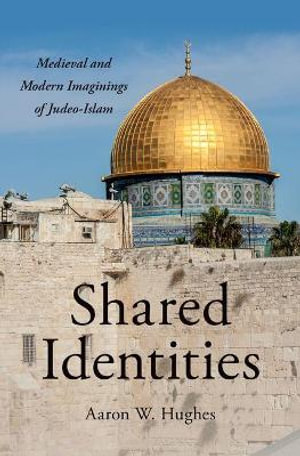
Received opinion imagines Judaism and Islam as two distinct religions interacting in the centuries following the death of Muhammad in the early seventh century. Tradition describes the relations between the two groups using such tropes as "symbiosis." In this revisionist work, Aaron W. Hughes instead argues that various porous and marginal groups-neither fully Muslim nor fully Jewish-exploited a shared terminology to make sense of their social worlds in response to the rapid process of Islamicization. What emerged as normative rabbinic Judaism on the one hand, and Sunni and ShiEven the spread of rabbinic Judaism, especially at the hands of Saadya Gaon (882-942 CE), was articulated Islamically. In the so-called "Golden Age" that emerged in places like Muslim Spain and North Africa, this "Islamic" Judaism could still be found in the writings of luminaires such as Bahya ibn Paquda, Abraham ibn Ezra, Judah Halevi, and Moses Maimonides.
Drawing on social theory, comparative religion, and the analysis of original sources, Hughes presents a compelling case for rewriting our understanding of Jews and Muslims in their earliest centuries of interaction. Not content to remain solely in the past, Shared Identities examines the continued interaction of Muslims and Jews, now reimagined as Palestinians and Israelis, into the present.
Industry Reviews
"In Shared Identities: Medieval and Modern Imaginings of Judeo-Islam, Aaron W. Hughes reminds us of the important role of intellectuals, historiographers, and deconstructionists who decode the past in finding a solution for today's conflicts For academics and activists, Hughes not only suggests a philological reading of the past but also a critical re-reading of the literature that emerged in the 18th and 19th centuries, which has shaped our
understandings of, and approaches to, the 'Other.' Thus, this could be considered an important contribution to the history of religion, religious studies, and the Middle East."--Majid Daneshgar, Reading Religion
"Aaron Hughes has produced another brilliant book. Officiating at a happy marriage between history and religious studies, he has given us a new vision of the emergence of Judaism and Islam in the sixth to the twelfth centuries. The book is thrilling in its scholarship and exemplary for future research in religious studies in other chronotopes."--Daniel Boyarin, Taubmann Professor of Talmudic Culture, University of California, Berkeley
"Aaron Hughes rethinks the complex relationship between Judaism and Islam without succumbing to the conventional view of symbiosis, which assumes two essential religions influencing each other but remaining fundamentally unchanged in their presumed internal cores of stability and self-definition. This timely and groundbreaking historical analysis will undoubtedly be provocative in the best sense, stimulating serious reconsideration of the identity formation of
two religious traditions that continue to play an important role in the sociopolitical machinations of world history."--Elliot R. Wolfson, Marsha and Jay Glazer Chair in Jewish Studies, University of
California, Santa Barbara
"This is a highly original work by a leading thinker in the field of Religious Studies. Aaron Hughes pushes the boundaries in calling into question notions of normativity concerning the Jewish communities of the medieval Islamic world and Jewish and Muslim identity at the rise of Islam, challenges fixed categories and concepts used to describe Jewish-Muslim interactions over the centuries, and provides a wide-ranging assessments of such themes as the Jewish
communities of Arabia at the rise of Islam to Jewish-Muslim interaction during the 'Golden Age' of Al-Andalus in the tenth and eleventh centuries and the modern day Palestinian-Israeli conflict. Hughes's
interpretations encourage further discussion and deliberation and his conclusions are a welcome contribution to the debate concerning Jewish and Muslim identity in past, present, and future."--Josef Meri, Center for the Study of Jewish-Christian-Muslim Relations, Merrimack College






![NRSV Catholic Bible Gift Edition [Brown] : Holy Bible - Thomas Nelson](https://www.booktopia.com.au/covers/200/9780785230397/0116/nrsv-catholic-bible-gift-edition-brown-.jpg)
![NRSV Catholic Bible Gift Edition [Teal] : Holy Bible - Thomas Nelson](https://www.booktopia.com.au/covers/200/9780785230410/0115/nrsv-catholic-bible-gift-edition-teal-.jpg)
![NRSV Catholic Bible Gift Edition [White] : Holy Bible - Thomas Nelson](https://www.booktopia.com.au/covers/200/9780785230380/0721/nrsv-catholic-bible-gift-edition-white-.jpg)

