Get Free Shipping on orders over $79
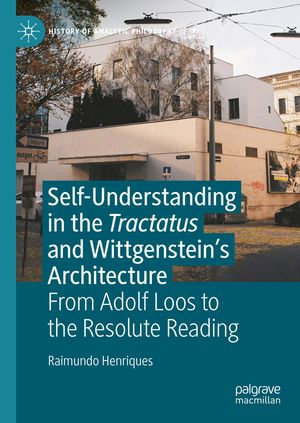
Self-understanding in the Tractatus and Wittgenstein's Architecture : From Adolf Loos to the Resolute Reading - Raimundo Henriques

Self-understanding in the Tractatus and Wittgenstein's Architecture

From Adolf Loos to the Resolute Reading

By: Raimundo Henriques

eText | 16 July 2024

At a Glance

eText


$199.00

or 4 interest-free payments of $49.75 with

 or 

Instant online reading in your Booktopia eTextbook Library *

Why choose an eTextbook?

Instant Access *

Purchase and read your book immediately

Read Aloud

Listen and follow along as Bookshelf reads to you

Study Tools

Built-in study tools like highlights and more

* eTextbooks are not downloadable to your eReader or an app and can be accessed via web browsers only. You must be connected to the internet and have no technical issues with your device or browser that could prevent the eTextbook from operating.

Between 1926 and 1928, the philosopher Ludwig Wittgenstein designed a house for his sister in Vienna (the Kundmanngasse). This book aims to clarify the relation between that house and Wittgenstein's early philosophy. The starting point of its main argument is a remark from Diktat fur Schlick (c. 1932-33) in which Wittgenstein proposes an analogy between ornaments and nonsensical sentences. The attempt to extract from it an account of the relation between the Kundmanngasse and the Tractatus Logico-Philosophicus (1921) leads to the writings of Adolf Loos (whose influence Wittgenstein recognized). The discussion of Loos's writings suggests that the analogy should be understood, not as one between actual ornaments and nonsensical sentences, but as one between Loos's and Wittgenstein's uses of these notions. So understood, it favors the (so-called) resolute reading of the Tractatus and reveals that both Wittgenstein's use of 'nonsense' and Loos's use of 'ornaments' are means to the end of promoting self-understanding. The book concludes that both the Kundmanngasse and the Tractatus are results of Wittgenstein's efforts at this kind of self-understanding. These can be construed as ways of acknowledging our humanity, which in turn can be seen as a unifying element of Wittgenstein's philosophy.

on
Desktop
Tablet
Mobile

More in Architecture

Apartments : Defining Style - Mariette Himes Gomez

eBOOK

Baking Soda Bonanza - Peter A. Ciullo

eBOOK

RRP $25.99

$20.99

19%
OFF
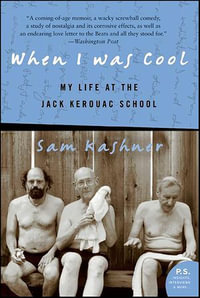
When I Was Cool : My Life at the Jack Kerouac School - Sam Kashner

eBOOK

American Son : My Story - Oscar De La Hoya

eBOOK

RRP $25.99

$20.99

19%
OFF