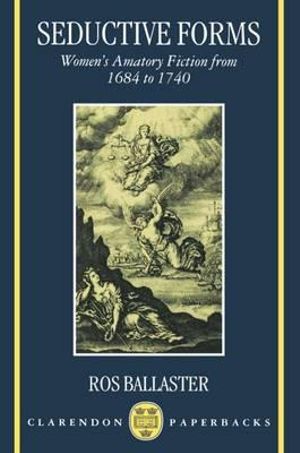
Historicist and feminist accounts of the `rise of the novel'' have neglected the phenomenon of the professional woman writer in England prior to the advent of the sentimental novel in the 1740s. Seductive Forms explores the means by which the three leading Tory women novelists of the late seventeenth and early eighteenth centuries challenged and reworked both contemporary gender ideologies and generic convention. The seduction plot provided Aphra Behn, Delarivier Manley, and Eliza Haywood with a vehicle for dramatizing their own appropriation of the `masculine'' power of fiction-making. Seduction is employed in these fictions as a metaphor for both novelistic production (the seduction of the reader by the writer) and party political machination (the seduction of the public by the politician). This challenging and lively book also explores the debts early prose fiction owed to French seventeenth-century models of fiction-writing and argues that Behn, Manley, and Haywood succeed in producing a distinctively `English'' and female `form'' for the amatory novel.
Industry Reviews
`a subtle blend of close readings of texts and their discursive contexts that makes a theoretically astute contribution to current efforts to rethink the "rise" of the British novel while raising discussion of the amatory fiction of Behn, Manley, and Haywood to a new level of seriousness and complexity ... With energy, intelligence, and erudition Ballaster performs the hybridzing intellectual work necessary to shift the boundaries of current critical
practices and define new areas of scholarly inquiry ... This critically engaged and engaging book opens a new chapter in the history of Anglo-American literary historiography, advancing readings and arguments
that no respectable future work on the early history of the British novel will legitimately be able to ignore.'
ECS 27:1 (Jan 1994)
`Ballaster illuminatingly analyses the crucial relation between earlier French women's fiction and English women's writing.'
Studies in English Literature
`In a style that is never dull, never full of jargon, Ballaster engages the reader in an exciting examination of early women's fiction. An important book.'
A. Jenkins, Georgia Institute of Technology, Choice, March 1993
'Ballaster has read, absorbed, and deployed a remarkable range of critical methods to makle sense of this genre. Even where she does not manage to make the texts themselves interesting, one reads for the inventiveness of Ballaster's own critical efforts ... fine new work of literary history.'
Ruth Perry, Massachusetts Institute of Technology, Albion, Vol. 25, No. 3, Fall 1993
'Ros Ballaster's challenging account of early women's fiction neither overlooks the role of gender ideology in the novels' formation, as most literary histories do, nor takes the relation between gender and genre as a given, as do many feminist accounts. Ballaster's important book will extend our understanding of gender and genre, and stimulate further investigation.'
Jane Spencer, University of Exeter, British Journal for Eighteenth-Century Studies, Vol. 17, Part 1, Spring 1994
'As ways of reading such texts at the present critical moment, Ballaster's approach is provocative and even arreesting ... very useful and spirited book.'
John Richetti, University of Pennsylvania, Modern Language Review, 25, 1995
`...an extraordinarily rich and interesting book...the range of sources is extensive, the readings provocative, and the grasp of the relation between text and culture both assured and suggestive. And, again characteristically, the subtlety of the feminist theory she deploys allows a persuasive new reading of the problematic 'rise of the novel'.'
Review of English Studies
Reviews of the hardback:
'a subtle blend of close readings of texts and their discursive contexts that makes a theoretically astute contribution to current efforts to rethink the "rise" of the British novel while raising discussion of the amatory fiction of Behn, Manley, and Haywood to a new level of seriousness and complexity. ... With energy, intelligence, and erudition, Ballaster performs the hybridizing intellectual work necessary to shift the boundaries of current critical
practices and define new areas of scholarly inquiry ... This critically engaged and engaging book opens a new chapter in the history of Anglo-American literary historiography, advancing readings and arguments
that no respectable future work on the early history of the British novel will legitimately be able to ignore.' Eighteenth-Century Studies
'Ballaster has read, absorbed, and deployed a remarkable range of critical methods to make sense of this genre. ... Even where she does not manage to make the texts themselves interesting, one reads for the inventiveness of Ballaster's own critical efforts.' Albion
'Ros Ballaster's challenging account of early women's fiction neither overlooks the role of gender ideology in the novel's formation, as most literary histories do, nor takes the relation between gender and genre as a given, as do many feminist accounts. ... Ballaster's important book will extend our understanding of gender and genre, and stimulate further investigation.' British Journal for Eighteenth-Century Studies