Get Free Shipping on orders over $79
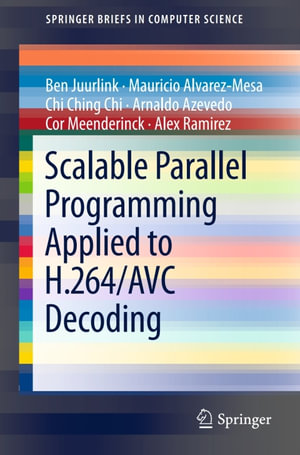
Scalable Parallel Programming Applied to H.264/AVC Decoding - Ben Juurlink

Scalable Parallel Programming Applied to H.264/AVC Decoding

By: Ben Juurlink, Mauricio Alvarez-Mesa, ng Ching Chi, Arnaldo Azevedo, Alex Ramirez

eText | 1 June 2012

At a Glance

eText


$84.99

or 4 interest-free payments of $21.25 with

 or 

Instant online reading in your Booktopia eTextbook Library *

Why choose an eTextbook?

Instant Access *

Purchase and read your book immediately

Read Aloud

Listen and follow along as Bookshelf reads to you

Study Tools

Built-in study tools like highlights and more

* eTextbooks are not downloadable to your eReader or an app and can be accessed via web browsers only. You must be connected to the internet and have no technical issues with your device or browser that could prevent the eTextbook from operating.
Existing software applications should be redesigned if programmers want to benefit from the performance offered by multi- and many-core architectures. Performance scalability now depends on the possibility of finding and exploiting enough Thread-Level Parallelism (TLP) in applications for using the increasing numbers of cores on a chip. Video decoding is an example of an application domain with increasing computational requirements every new generation. This is due, on the one hand, to the trend towards high quality video systems (high definition and frame rate, 3D displays, etc) that results in a continuous increase in the amount of data that has to be processed in real-time. On the other hand, there is the requirement to maintain high compression efficiency which is only possible with video codes like H.264/AVC that use advanced coding techniques. In this book, the parallelization of H.264/AVC decoding is presented as a case study of parallel programming. H.264/AVC decoding is an example of a complex application with many levels of dependencies, different kernels, and irregular data structures. The book presents a detailed methodology for parallelization of this type of applications. It begins with a description of the algorithm, an analysis of the data dependencies and an evaluation of the different parallelization strategies. Then the design and implementation of a novel parallelization approach is presented that is scalable to many core architectures. Experimental results on different parallel architectures are discussed in detail. Finally, an outlook is given on parallelization opportunities in the upcoming HEVC standard.
on
Desktop
Tablet
Mobile

More in Computer Programming & Software Development

The End of Leadership - Barbara Kellerman

eBOOK