Get Free Shipping on orders over $79
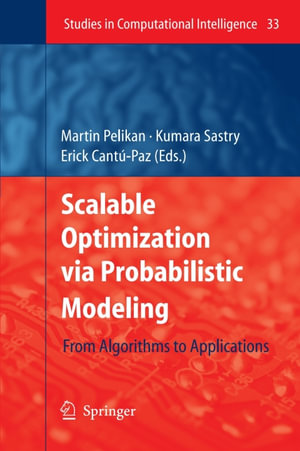
Scalable Optimization via Probabilistic Modeling : From Algorithms to Applications - Martin Pelikan

Scalable Optimization via Probabilistic Modeling

From Algorithms to Applications

By: Martin Pelikan, ?Kumara Sastry, ?Erick CantúPaz

eText | 12 January 2007 | Edition Number 1

At a Glance

eText


$239.00

or 4 interest-free payments of $59.75 with

 or 

Instant online reading in your Booktopia eTextbook Library *

Why choose an eTextbook?

Instant Access *

Purchase and read your book immediately

Read Aloud

Listen and follow along as Bookshelf reads to you

Study Tools

Built-in study tools like highlights and more

* eTextbooks are not downloadable to your eReader or an app and can be accessed via web browsers only. You must be connected to the internet and have no technical issues with your device or browser that could prevent the eTextbook from operating.
I'm not usually a fan of edited volumes. Too often they are an incoherent hodgepodge of remnants, renegades, or rejects foisted upon an unsuspecting reading public under a misleading or fraudulent title. The volume Scalable Optimization via Probabilistic Modeling: From Algorithms to Applications is a worthy addition to your library because it succeeds on exactly those dimensions where so many edited volumes fail. For example, take the title, Scalable Optimization via Probabilistic M- eling: From Algorithms to Applications. You need not worry that you're going to pick up this book and ?nd stray articles about anything else. This book focuseslikealaserbeamononeofthehottesttopicsinevolutionary compu- tion over the last decade or so: estimation of distribution algorithms (EDAs). EDAs borrow evolutionary computation's population orientation and sel- tionism and throw out the genetics to give us a hybrid of substantial power, elegance, and extensibility. The article sequencing in most edited volumes is hard to understand, but from the get go the editors of this volume have assembled a set of articles sequenced in a logical fashion. The book moves from design to e?ciency enhancement and then concludes with relevant applications. The emphasis on e?ciency enhancement is particularly important, because the data-mining perspectiveimplicitinEDAsopensuptheworldofoptimizationtonewme- ods of data-guided adaptation that can further speed solutions through the construction and utilization of e?ective surrogates, hybrids, and parallel and temporal decompositions.
on
Desktop
Tablet
Mobile

More in Probability & Statistics