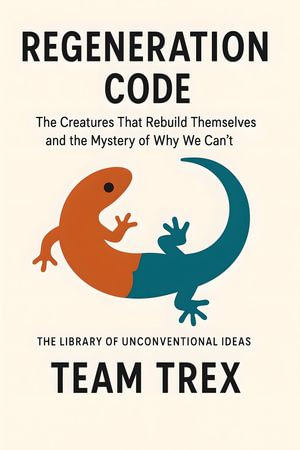
If you cut a planarian worm in half, you get two worms. If a salamander loses a limb, it grows a perfect replacement. Yet, when humans suffer similar injuries, we are left with nothing but scars. This book tackles one of biology's most tantalizing mysteries: why did mammals lose the superpower of regeneration? Written for the inquisitive mind, it bridges the gap between the pond and the hospital, explaining the fundamental rules that dictate life, death, and repair.
You will journey into the cellular machinery of the superstars of regrowth, discovering how they turn back biological time to summon new tissue from old. From the invisible chemical maps that guide a growing finger to the electric conversations between nerves and skin, the text reveals the precise blueprints of reconstruction. It also confronts the Faustian Bargain of human biology, exploring the controversial theory that our inability to regenerate is the evolutionary price we pay to suppress cancer.
Part of The Library of Unconventional Ideas, this volume avoids vague metaphors in favor of measurable science and developmental constraints. It offers a clear, sophisticated look at the Regeneration Code written in our DNA, exploring a set of genetic instructions that is currently dormant, but perhaps not deleted.