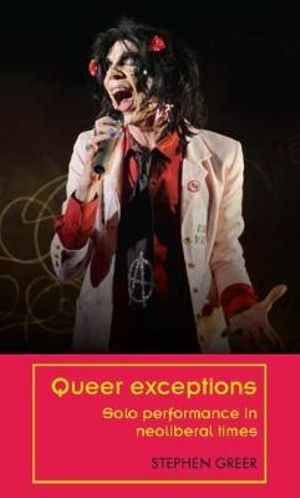
This book is a study of post-millennial solo performance in the UK and Western Europe that explores the contentious relationship between identity, individuality and neoliberalism. Featuring artists as varied as La Ribot, David Hoyle, Neil Bartlett, Bridget Christie, Rosana Cade and Tanja Ostojic, it provides an essential account of the diverse practices which characterise contemporary solo performance, and their significance to debates concerning equality, community and social participation. By moving between the practices and traditions of theatrical monologue, stand-up comedy, cabaret and live art, it identifies vulnerability, complicity and optimism as key responses to neoliberalism’s preference – if not demand – for self-made subjects.
Beginning in a study of the arts festivals which characterise the economies in which solo performance circulates, each chapter animates a different cultural trope – including the martyr, the killjoy, the invalid and the stranger – to explore the significance of ‘exceptional’ subjects whose precarious social status challenges assumed notions of communal sociability. These figures invite us to re-examine theatre’s attachment to singular lives and experiences, and provide a new account of the role of autobiographical performance and the explicit body in negotiating the relationship between the personal and the political.
Informed by the work of scholars including Sara Ahmed, Zygmunt Bauman and Giorgio Agamben – and located at the intersection of queer and performance studies – this interdisciplinary text offers an incisive analysis of the cultural significance of solo performance for students and scholars across the fields of theatre studies, sociology, gender studies and political philosophy.
Industry Reviews
'Rising to the promise that the title holds out, this excellent book will be of value to all scholars with an interest in contemporary performance practices. It gives deep and well-informed insight into not only the creation and presentation of solo performance work but the economic realities within which it is embedded [...]Greer's palette is broad and wide-ranging, though this not in any way at the expense of detail - far from it. This brilliant addition to scholarly considerations of contemporary theatre practices is deeply rooted in an insider's understanding of the logistics, economics, and sheer hard work that underpins solo performance.'
Alison Jeffers, New Theatre Quarterly, Vol. 35, No. 2 (May 2019)
'This wide-ranging, brilliant, and scholarly volume adds a much-needed perspective on and assessment of queer solo performance: one that does not simply venerate it as identity validation nor dismiss it as a tool of neoliberal identity consumption, but that instead articulates how the works analysed offer twenty-first-century radical performance politics looking at, out, through, and beyond the performance of 'the singular subject in neoliberal times''
Contemporary Theatre Review
'Through an examination of contemporary European solo performance, Stephen Greer explores the form's simultaneous resistance to and compatibility within neoliberalism.'
The Drama Review
'Queer Exceptions... catalogues a breadth of innovative performance practices, making it a valuable read for contemporary performance scholars. The application of a figural approach further offers a provocation to scholars across the discipline to reconsider ways in which we hold performance practices together.'
Theatre Research International