Get Free Shipping on orders over $79
Microworlds - Stanislaw Lem

Microworlds

By: Stanislaw Lem

Paperback | 1 March 1997

Sorry, we are not able to source the book you are looking for right now.

We did a search for other books with a similar title, however there were no matches. You can try selecting from a similar category, click on the author's name, or use the search box above to find your book.

Ten essays examining the scientific premises of Lem's own works and those of others. He believes that science fiction and fantasy should be a laboratory of discovery of what has not been done or thought before, and he writes about what he regards as science fiction's squandered potential.
Industry Reviews
Ten essays, 1971-83: ranging from autobiography through analyses of the underpinnings of sf to examinations of specific authors and works - delivered in thunderous yet calculated tones, and a welter of academic polysyllables. The autobiographical piece is most engaging and revealing - with Lem candidly discussing his upbringing, his Jewish heritage, the German and Russian occupations of Poland, his own sf. Elsewhere, he demonstrates his formidable intellect and his self-imposed conceptual limitations: he finds fiction without intellectual challenge boring (and has no patience with the notion of fiction as entertainment); in his view, sf works in which neither the objects nor the ideas have any basis in reality are merely "empty games." Later, however, Lem cogently discusses sf's various time-travel motifs - notwithstanding his previous denunciation of "empty games" where "impossible time-travel machines are used to point out impossible time-travel paradoxes." "The primary unsolved problem" of sf, he writes, is "the lack of a theoretical typology of its paradigmatic structures" - yet he fails to demonstrate why this lack is so damaging. On the incestuous nature of Western sf, he's devastating: "critiques are not produced independently, but are written by either the authors or the editors of anthologies, who evaluate each other's works." (He also blasts publishers and editors for camouflaging advertising as criticism.) For all these reasons, sf is trashy and apt to remain so. Moving on to specifics, Lem shows himself to be a penetrating but often arbitrary and petulant critic. Just about the only Western sf author he approves of (Ballard and Bradbury rate a maybe) is Philip K. Dick - who "tries to probe the neglected, latent, untouched, as-yet-unrealized potentialities of human existence." A. E. van Vogt's work is condemned as "stupid lies" without a shred of evidence or analysis; Borges, Lem determines, "has suffered from a lack of a free and rich imagination." He criticizes Daniel Keyes' Flowers for Algernon for what Leto thinks Keyes' should have written; the Strugatsky brothers' Roadside Picnic - which Leto not only analyzes brilliantly, but finds enjoyable - comes in for similar treatment. Clearly, there's some ax-grinding going on. In sum: guaranteed to offend and provoke. (Kirkus Reviews)

More in Literary Theory

Middlemarch : Collins Classics - George Eliot
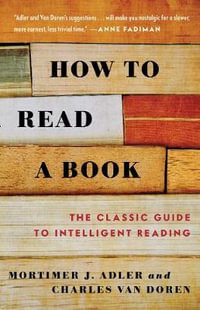
How to Read a Book : A Touchstone book - Charles Van Doren

RRP $34.99

$18.75

46%
OFF
Experimental Criticism : Franco Moretti and Literature - Francesco de Cristofaro
In Love with Love : The Persistence and Joy of Romantic Fiction - Ella Risbridger
An Introduction to Literature, Criticism and Theory : 6th Edition - Andrew Bennett
Poetics : Penguin Classics - Aristotle

RRP $26.99

$20.75

23%
OFF
Camera Lucida : Vintage Classics - Roland Barthes

RRP $26.99

$15.99

41%
OFF
Create Dangerously : Penguin Modern - Albert Camus
Metaphors We Live By - George Lakoff

$34.75

Literacies : 2nd edition - Mary Kalantzis

RRP $145.95

$117.75

19%
OFF
Literary Theory : An Introduction - Terry Eagleton

RRP $38.95

$31.75

18%
OFF