

Get Free Shipping on orders over $89
Problem Solving Courts : Social Science and Legal Perspectives - Eve M. Brank

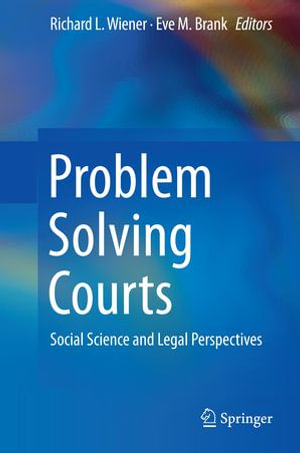
Problem Solving Courts

Social Science and Legal Perspectives

By: Eve M. Brank (Editor), Richard L. Wiener (Editor)

eText | 11 July 2013

At a Glance

eText


$269.01

or 4 interest-free payments of $67.25 with

 or 

Instant online reading in your Booktopia eTextbook Library *

Why choose an eTextbook?

Instant Access *

Purchase and read your book immediately

Read Aloud

Listen and follow along as Bookshelf reads to you

Study Tools

Built-in study tools like highlights and more

* eTextbooks are not downloadable to your eReader or an app and can be accessed via web browsers only. You must be connected to the internet and have no technical issues with your device or browser that could prevent the eTextbook from operating.

In order to make the criminal court system more effective there has been a growing trend to have courts participate in what is essentially a rehabilitation strategy. Such courts are often referred to as "problem-solving" because they are working on root causes of criminal behavior as part of the dispensation of justice. This major shift in the role of the courts means that the court works closely with prosecutors, public defenders, probation officers, social workers, and other justice system partners to develop a strategy that pressures offenders to complete a treatment program which will ultimately, hopefully prevent recidivism. Research has shown that this kind of strategy has a two-fold benefit. It has been successful in helping offenders turn their lives around which leads to improved public safety and the ultimate saving of public funds. This book is the first to focus exclusively on problem solving courts, and as such it presents an overview of the rationale and scientific evidence for such courts as well as individual sections on the key areas in which these courts are active. Thus there is specific attention paid to domestic violence, juvenile criminality, mental health, and more. Throughout, research findings are incorporated into general discussions of these courts operate and ideally what they are trying to accomplish. There is also discussion of how such courts should evolve in the future and the directions that further research should take.

on
Desktop
Tablet
Mobile

More in Psychology