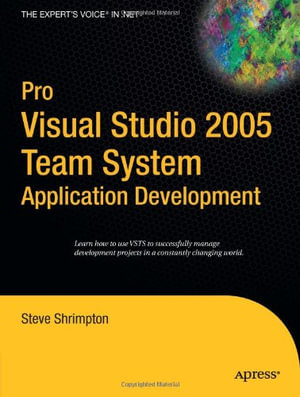
| About the Author | p. xvii |
| About the Technical Reviewer | p. xvii |
| Acknowledgments | p. xix |
| Introduction | p. xxi |
| Introducing Microsoft Visual Studio 2005 Team System | p. 1 |
| The Need for Team System | p. 1 |
| Microsoft Visual Studio 2005 Team System | p. 5 |
| Visual Studio 2005 Team Edition for Software Architects | p. 5 |
| Visual Studio 2005 Team Edition for Software Developers | p. 5 |
| Visual Studio 2005 Team Edition for Software Testers | p. 7 |
| Visual Studio 2005 Team Suite | p. 7 |
| Visual Studio 2005 Team Foundation Server | p. 7 |
| How Team System Is Described in This Book | p. 8 |
| Distributed Applications | p. 9 |
| Service-Oriented Architectures | p. 14 |
| The Smart Client Approach | p. 17 |
| Evolution of the Client-Server Architecture | p. 17 |
| Thin Clients and the N-Tier Architecture | p. 18 |
| Smart Client Applications | p. 20 |
| Summary | p. 23 |
| The Business Case and Project Scope | p. 25 |
| The Business Justification | p. 25 |
| The High-Level Requirements | p. 26 |
| Existing Enterprise System Architecture | p. 27 |
| Resource Manager | p. 28 |
| Sales Manager | p. 33 |
| Icarus Sales Website | p. 38 |
| Vendor Information Website | p. 40 |
| Sales Watch MIS Application | p. 41 |
| Periodic Batch Process | p. 41 |
| Orchestration Service | p. 41 |
| Document Service | p. 42 |
| Email Service | p. 42 |
| Payment Service | p. 42 |
| General Ledger Service | p. 42 |
| Enter the Consultants | p. 42 |
| The Architectural Vision | p. 43 |
| The Kickoff Meeting | p. 44 |
| Summary | p. 52 |
| The Project Manager: Initial Tasks and Project Planning | p. 53 |
| Innovation from the Subcontinent | p. 53 |
| Choice of a Development Process | p. 54 |
| Microsoft Solution Framework | p. 55 |
| Installing Team System | p. 57 |
| Project Manager: Creating the Team Project | p. 60 |
| The Project Portal | p. 64 |
| Automatically Generated Tasks for the MSF for CMMI Process Improvement Project | p. 65 |
| The First Planning Meeting | p. 66 |
| Setting Permissions | p. 70 |
| Assigning Tasks | p. 71 |
| Create Iteration Plan-Iteration 0 | p. 73 |
| Summary of the Tasks in Iteration 0 | p. 77 |
| Create Vision Document | p. 78 |
| Create Personas | p. 78 |
| Create Scenarios | p. 78 |
| Create Project Structure | p. 78 |
| Create Quality of Service (QOS) Requirements | p. 79 |
| Create Master Schedule | p. 80 |
| Create Project Plan | p. 80 |
| Create Solution Architecture | p. 81 |
| Summary of Tasks-Iteration 1 | p. 81 |
| Prioritize Scenarios | p. 81 |
| Create Iteration Plan | p. 81 |
| Write Scenarios | p. 81 |
| Storyboard Scenarios | p. 81 |
| Create Product Requirements | p. 82 |
| Establish Environments | p. 82 |
| Create Configuration Management Plan | p. 82 |
| Create Test Approach Worksheet | p. 82 |
| The Project Plan: Defining the Budget and Schedule | p. 82 |
| Date Driven or Scope Driven? | p. 83 |
| High-Level Dependencies | p. 83 |
| Dividing the Schedule into Iterations | p. 85 |
| Major Risk Areas | p. 86 |
| Divide Functionality Across Iterations | p. 87 |
| Summary | p. 91 |
| The Business Analyst: Creating the Personas, Use Cases, and Scenarios | p. 93 |
| The Requirements Process | p. 93 |
| What About Use Cases? | p. 94 |
| Define Personas | p. 97 |
| Personas: Icarus Employees | p. 99 |
| Personas: Customers | p. 101 |
| Personas: Vendors | p. 101 |
| Use Case Analysis | p. 102 |
| Sales Use Case | p. 103 |
| Browse Catalog Use Case | p. 106 |
| Manage Orders | p. 111 |
| Offline Working for Travel Agents | p. 112 |
| Listings | p. 116 |
| Query Orders | p. 118 |
| Identifying the Top-Level Scenarios | p. 118 |
| Order Scenarios | p. 120 |
| Creating the Browse Resource Catalog Scenarios-In Detail | p. 121 |
| Navigate Resource Catalog Scenarios | p. 126 |
| Search Catalog Scenarios | p. 128 |
| Offline Browse Catalog | p. 128 |
| Writing a New Scenario Query-Offline Catalog Synchronization | p. 128 |
| Manage Orders Scenarios | p. 133 |
| View Orders Scenarios | p. 134 |
| Listings | p. 135 |
| Create Quality of Service Requirements | p. 136 |
| Performance | p. 136 |
| Load | p. 137 |
| Availability | p. 138 |
| Serviceability | p. 138 |
| Maintainability | p. 138 |
| Summary | p. 138 |
| The Architect: Creating the Solution Architecture | p. 139 |
| Creating the Solution | p. 139 |
| Checking the Work into TFS | p. 142 |
| Application Diagrams | p. 145 |
| What Is an Application? | p. 145 |
| Application Prototypes Available in Team System | p. 146 |
| Connecting Applications | p. 147 |
| WebServiceEndpoint | p. 148 |
| WebContentEndpoint | p. 148 |
| DatabaseEndpoint | p. 148 |
| GenericEndpoint | p. 148 |
| Customizing Endpoints | p. 148 |
| Application Settings | p. 149 |
| Settings Available for the Prototype Applications | p. 149 |
| Application Constraints | p. 150 |
| Application Diagrams for Icarus Enterprise 3.1 | p. 152 |
| Creating an Application Diagram for the Existing Application | p. 152 |
| Using the Legacy Applications As Prototypes | p. 156 |
| Creating the Application Diagram for the New Solution | p. 157 |
| Stub and Test Harness Applications for the New Solution | p. 162 |
| Multiple Instances of the Same Web Service | p. 163 |
| Designing the Production Systems | p. 164 |
| The Concept of a System | p. 164 |
| The Production Systems | p. 165 |
| BusinessLogic System | p. 165 |
| Presentation System | p. 167 |
| California Office System | p. 168 |
| The Icarus Global System | p. 169 |
| Vertical Slices and Systems Containing Other Systems | p. 171 |
| Deployment | p. 171 |
| Logical Data Center Designer and Its Concepts | p. 172 |
| Zones | p. 173 |
| Zone Constraints | p. 173 |
| Zone Endpoints and Their Constraints | p. 174 |
| Logical Servers | p. 175 |
| The Icarus Production Data Centers | p. 175 |
| California Data Center | p. 176 |
| High Security Zone | p. 176 |
| The Other Zones in the California Data Center | p. 180 |
| Deployment in the California Data Center | p. 183 |
| Global Data Center | p. 187 |
| Summary | p. 194 |
| Business Analyst and Design Team: Designing the Application | p. 195 |
| Work Streams, Activities, Work Products, and Iterations | p. 195 |
| Iteration Sequence Is Goal Oriented | p. 197 |
| Planning Iteration 1 | p. 198 |
| The Plan for Iteration 1 | p. 202 |
| Writing the Scenarios | p. 206 |
| Offline Critical Scenarios | p. 206 |
| Storyboarding the Scenarios | p. 207 |
| Customer Management Scenarios | p. 208 |
| Manage Reservations Scenarios | p. 214 |
| Web Sales Scenarios | p. 218 |
| Listing Scenarios | p. 221 |
| Product Requirements | p. 228 |
| Develop a User Interface Flow Model | p. 229 |
| Develop a Domain Model | p. 229 |
| Develop Functional Requirements | p. 229 |
| Develop Interface Requirements | p. 229 |
| Develop Security Requirements | p. 229 |
| Develop Safety Requirements | p. 229 |
| Develop Operation Requirements | p. 230 |
| Allocate Product Component Requirements | p. 230 |
| Prioritize Functionality | p. 230 |
| Validate Requirements | p. 230 |
| Exploring Alternative Architectures | p. 230 |
| Solution Architecture Design | p. 232 |
| Offline Working Architecture | p. 232 |
| The Application Diagram for Iteration 1 | p. 235 |
| The Proof-of-Concept System and Its Deployment | p. 237 |
| Agent Sales System | p. 237 |
| Direct Sales System | p. 239 |
| Listing System | p. 240 |
| The Development and Test Environment Treated As a Data Center | p. 241 |
| Data Model | p. 245 |
| Generating the Database DDL Scripts | p. 259 |
| The Seed Data Scripts | p. 264 |
| The Test Data Scripts | p. 265 |
| Summary | p. 265 |
| Prototype Group: Proof of Concept Development | p. 267 |
| Sales Business Objects-The Customer Business Entity | p. 267 |
| The Data Access Layer | p. 268 |
| Problems with Web References | p. 285 |
| The Sales Web Service Stub | p. 287 |
| Business Entities and Datasets | p. 288 |
| The Business Entity Layer | p. 290 |
| Business Entity Base Classes | p. 291 |
| Customer Business Entity | p. 292 |
| Customer Search Business Entity | p. 301 |
| The Sales Web Service | p. 303 |
| Prototyping the Sales Wing Windows Forms Smart-Client Application | p. 305 |
| Creating the Main Screen | p. 305 |
| The CustomerDetails User Control | p. 307 |
| Binding the Typed Datasets to the CustomerDetails Control | p. 309 |
| The Open Customer Dialog Box | p. 316 |
| Prototyping the Sales Site Application | p. 319 |
| The Master Page and the "My Wings" Page | p. 320 |
| The My Orders Page | p. 328 |
| The Order Detail Page | p. 337 |
| The Make Reservation Page | p. 338 |
| Prototyping the List Wing Windows Forms Application | p. 344 |
| The List Wing Windows Forms | p. 344 |
| The Listing Business Objects Stubs | p. 349 |
| Summary | p. 351 |
| Development Team: Sales Business Layer Development | p. 353 |
| Adding the Prototype Code to Source Control | p. 353 |
| Opening the Project from Source Control | p. 353 |
| Creating the Order Data Access Component Classes | p. 358 |
| Testing the Data Access Layer | p. 364 |
| Class Initialization | p. 370 |
| Order Fill Test Sequence | p. 370 |
| Order Update Test Sequence | p. 370 |
| Class Cleanup | p. 371 |
| Unit-Test Design | p. 371 |
| Unit-Test Code | p. 377 |
| Running the Unit Tests | p. 381 |
| Checking the Code into Version Control | p. 383 |
| The Order Business Entity Class | p. 387 |
| Testing the Business Entity Layer: Read Capability | p. 398 |
| Parameterizing the Database Connection and Web Service URL | p. 404 |
| Problems with Sequences of Unit Tests | p. 405 |
| Testing the Business Layer: Write Capability | p. 411 |
| Test Coverage | p. 412 |
| Static Code Analysis Check-In Policy | p. 414 |
| Test Manager | p. 417 |
| Check-In Testing Policy | p. 418 |
| Static Code Analysis: BusinessEntity Project | p. 420 |
| Making Static Variables Non-Public | p. 422 |
| Avoiding Static Constructors (CA1810) | p. 425 |
| Do Not Declare Static Members on Generic Types (CA1000) | p. 427 |
| Types That Own Disposable Fields Should Be Disposable (CA1001) | p. 427 |
| Declare Event Handlers Correctly and Should Have the Correct Suffix (CA1009, CA1710, CA1711) | p. 428 |
| Use Generic Event Handler Instances (CA1003) | p. 428 |
| Do Not Declare Visible Instance Fields (CA1051) | p. 429 |
| Long Acronyms Should Be Pascal Cased (CA1705) | p. 430 |
| Assemblies Should Declare Minimum Security (CA2209) | p. 430 |
| Mark Assemblies with CLS Compliant (CA1014) | p. 430 |
| Assemblies Should Have Valid Strong Names (CA2210) | p. 430 |
| Naming Conventions (CA1709) | p. 431 |
| Avoid Excessive Parameters on Generic Types (CA1005) | p. 431 |
| Static Code Analysis: OrderDAL Project | p. 432 |
| Static Code Analysis: OrderBE Project | p. 433 |
| Checking In OrderBE and Its Related Projects | p. 434 |
| Updating the Work Items | p. 436 |
| Summary | p. 436 |
| Integration and Functional Testing | p. 439 |
| The Listing Business Objects Data Access Layer | p. 439 |
| The VendorDS Dataset | p. 439 |
| Testing VendorDS | p. 443 |
| The VendorSearchDS Class | p. 445 |
| The ResourceDS Class | p. 446 |
| Testing VendorSearchDS and ResourceDS | p. 447 |
| Updating the Workspace | p. 447 |
| Multiple Code Checkout and Merging in TFS | p. 452 |
| When Merging Takes Place | p. 452 |
| How Merging Takes Place | p. 454 |
| Merging Groups of Files | p. 454 |
| The Listing Business Objects | p. 454 |
| The VendorBE Class | p. 455 |
| ListingWebServiceStub | p. 456 |
| Completing VendorBE | p. 459 |
| ResourceBE Class | p. 465 |
| Organizing the Team Build | p. 465 |
| Creating a Build Type | p. 465 |
| Executing a Build | p. 470 |
| The Sales System | p. 474 |
| Verifying the Read Behavior for Orders | p. 474 |
| Verifying the Write Behavior for Orders | p. 479 |
| Verifying the New Order Functionality | p. 480 |
| Testing the Sales Wing Application | p. 480 |
| The Sales Website Application | p. 483 |
| Displaying Orders and Reservations | p. 484 |
| Testing the Sales Site | p. 488 |
| Web Testing Individual Pages | p. 489 |
| Web Testing the Create Order Scenario | p. 496 |
| Summary | p. 501 |
| Web and Performance Testing | p. 503 |
| Load Testing of the Sales Site | p. 503 |
| Load Testing of the Order Creation Scenario | p. 503 |
| Creating a Load Test for the Sales Site | p. 506 |
| Running the Load Test Against the Sales Site | p. 516 |
| Interpreting the Load Test Data | p. 521 |
| Parameterizing Load Tests | p. 529 |
| Profiling the Sales Site Scenarios | p. 531 |
| Profiling by Sampling | p. 532 |
| Profiling by Instrumentation | p. 544 |
| Improving the Application Inclusive Time | p. 552 |
| Instrumenting Memory Allocations | p. 557 |
| Summary | p. 565 |
| Handling Change and Security Requirements | p. 567 |
| The Unexpected Meeting | p. 567 |
| Modified Offline Working Scenarios | p. 569 |
| Iteration 2 Change Branch: Create Solution Architecture | p. 570 |
| Resource Data Replication | p. 571 |
| Customer Replication and Order Merge | p. 572 |
| Iteration 2 Change Branch: Create Product Requirements | p. 572 |
| Iteration 2 Change Branch: Developing and Testing the Changes | p. 573 |
| Branching the Code | p. 574 |
| The Replication Data Access Layer Classes | p. 578 |
| The Replication Business Objects | p. 579 |
| The Replication Thread | p. 580 |
| Iteration 2 Main Branch: Security Use Cases and Scenarios | p. 582 |
| Sales Site Scenarios | p. 583 |
| Sales Wing Application Scenarios | p. 586 |
| Iteration 2 Main Branch: Create Application Architecture | p. 588 |
| ASP.NET Membership and Role Management | p. 589 |
| Data Model | p. 589 |
| Security Business Logic | p. 592 |
| Iteration 2 Main Branch: Create Product Requirements | p. 594 |
| Iteration 2 Main Branch: Developing and Testing Authentication and Authorization | p. 595 |
| Authenticating the Sales Site Client | p. 595 |
| Authenticating at the Web Service Access | p. 597 |
| Implementing Authorization | p. 597 |
| Single-Entity Authorization | p. 598 |
| Multiple-Entity Authorization | p. 600 |
| Managing Users | p. 602 |
| Merging the Branches, Iteration 3: Replication and Main Functionality | p. 602 |
| Summary | p. 613 |
| Managing Iterations: Moving Toward Completion | p. 615 |
| Planning Iterations 4 and 5 | p. 615 |
| Iteration 4 | p. 618 |
| Planning the Iteration | p. 618 |
| Defining the Scenario Work Items | p. 619 |
| Defining the Analysis Tasks | p. 621 |
| Reporting Capability | p. 624 |
| Analyzing the Scenarios and Defining the Development Tasks | p. 626 |
| Code Completion and Check-In | p. 636 |
| End of the Development Phase-Checking the Status | p. 640 |
| Planning the Test Effort | p. 642 |
| Manual Testing | p. 645 |
| Iteration 5 | p. 647 |
| Interfacing with Back-End Systems | p. 647 |
| Back-End Scenarios | p. 649 |
| Back-End Interface Architecture | p. 649 |
| Planning Iteration 5 | p. 651 |
| Developing the DCOM Interface | p. 651 |
| Developing the MSMQ Interface | p. 652 |
| Summary | p. 654 |
| Tracking and Correcting Defects | p. 657 |
| Discovering Bugs | p. 657 |
| Running a Manual Test and Discovering a Bug | p. 658 |
| The Bug Triage Process | p. 670 |
| Investigating the Bug | p. 675 |
| Debugging the ConfirmOrders() Function | p. 678 |
| Fixing the Bug | p. 682 |
| The Daily Build | p. 684 |
| Testing the Bug Fixes | p. 687 |
| Ongoing Testing and Bug Fixing | p. 690 |
| Everybody's a Tester | p. 694 |
| Summary | p. 695 |
| Releasing the Product | p. 697 |
| The Process Guidance | p. 697 |
| Establish a User Acceptance Test (UAT) Environment | p. 697 |
| Establish Validation Guidelines | p. 698 |
| Select Release Candidate | p. 698 |
| Create Rollout and Deployment Plan | p. 698 |
| User Acceptance Testing, Analyze User Acceptance Test Results, Accept Product for Release | p. 699 |
| Package Product | p. 699 |
| Execute Rollout Plan | p. 699 |
| Create Release Notes | p. 699 |
| Planning the User Acceptance Testing and Rollout | p. 700 |
| Designing the UAT/Production Logical Data Center and Verifying Deployment | p. 701 |
| The Final Production and UAT Application | p. 701 |
| The Sales Wing and List Wing Systems | p. 703 |
| The Icarus Presentation System | p. 706 |
| The User Acceptance Test System | p. 707 |
| Deployment of the UAT System | p. 708 |
| Deployment of the Production System | p. 711 |
| Designing the Product Packaging | p. 711 |
| Deployment Projects | p. 711 |
| Client Deployment: ClickOnce | p. 712 |
| Setup Projects for the Rest of the Applications | p. 717 |
| Data Migration | p. 718 |
| How It All Happened | p. 718 |
| Installing the UAT System | p. 718 |
| The User Acceptance Test | p. 718 |
| Go-Live Weekend | p. 719 |
| Debriefing and Wrap-Up | p. 720 |
| Requirements and Business Case | p. 720 |
| Architecture | p. 720 |
| Development and Unit Test | p. 721 |
| Application Testing and Deployment | p. 721 |
| General Comments About the Book | p. 722 |
| Epilogue | p. 722 |
| Index | p. 725 |
| Table of Contents provided by Ingram. All Rights Reserved. |