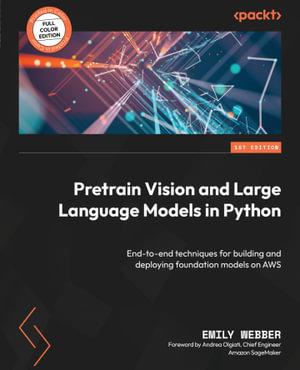
Conceptual fundamentals and practical guidance from industry experts to pretrain the large vision and language models of the future.
Key Features
- Learn how and where to develop, train, tune, and apply your own pretrained models
- Master distributed training concepts for models & datasets, with code examples for AWS and SageMaker
- Evaluate, deploy, and operationalize your custom models with bias detection and pipeline monitoring
Book Description
Large models have forever changed machine learning. From BERT to GPT-3, Vision Transformers to DALL-E, when billions of parameters are combined with large datasets and hundreds to thousands of GPUs, the result is nothing short of record-breaking. The recommendations, advice, and code samples in this book will help you pretrain your large models from scratch on AWS and Amazon SageMaker and apply them to hundreds of use cases across your organization.
With advice from seasoned AWS ML expert Emily Webber, this book provides everything you need to go from project ideation, dataset preparation, training, evaluation, and deployment for large language, vision, and multimodal models. With step-by-step explanations of essential concepts and practical examples, you'll go all the way from mastering the concept of pretraining itself to preparing your dataset and model, configuring your environment, training, evaluating, and deploying your models.
From applying the scaling laws to distributing your model and dataset over multiple GPUs, you'll learn how to successfully train, evaluate, and deploy your model on Amazon SageMaker. By the end of this book, you will have everything you need to embark on your own project to pretrain the large language models of the future, purpose-built for your organization.
What you will learn
- Prepare to train large models from the right dataset to your GPU needs
- Configure environments on AWS and SageMaker for optimal performance
- Select the right hyperparameters for your model, given your constraints
- Distribute your model and dataset with different types of parallelism
- Avoid pitfalls with job restarts, intermittent health checks, and more
- Evaluate your model with quantitative and qualitative insights
- Deploy your models with runtime improvements and Monitoring
- Detect and mitigate bias in your deploy and retrain pipelines
Who This Book Is For
If you're a machine learning enthusiast or researcher who wants to get started on your very own large modeling project, this book is for you. Applied scientists, data scientists, machine learning engineers, solution architects, product managers, and students will all enjoy the material. Basic Python is a must, and introductory concepts around cloud computing will be very helpful. We'll assume some level of deep learning fundamentals but will explain advanced topics.
Table of Contents
- An introduction to pretraining
- Dataset preparation: part one
- Model preparation
- Into the GPU
- Parallelization basics
- Dataset preparation: part two
- Find the right hyperparameters
- Make sure your loss goes down
- Troubleshoot ongoing performance
- Determine the right length of training time
- Finetune and compare with open source models
- Detect and mitigate bias
- How small can you go?
- Use cases: scale across organizations
- Ongoing operations, monitoring and maintenance